
A belt pulls hard on the shaft. The bearing takes the hit. Pick the wrong one, and it fails fast.
To choose deep groove ball bearings for belt-driven machinery, focus on radial load capacity from belt tension, select a bearing with adequate dynamic load rating (Cr), and consider double row bearings for high tension or misaligned pulleys. Also choose C3 internal clearance for heat management.
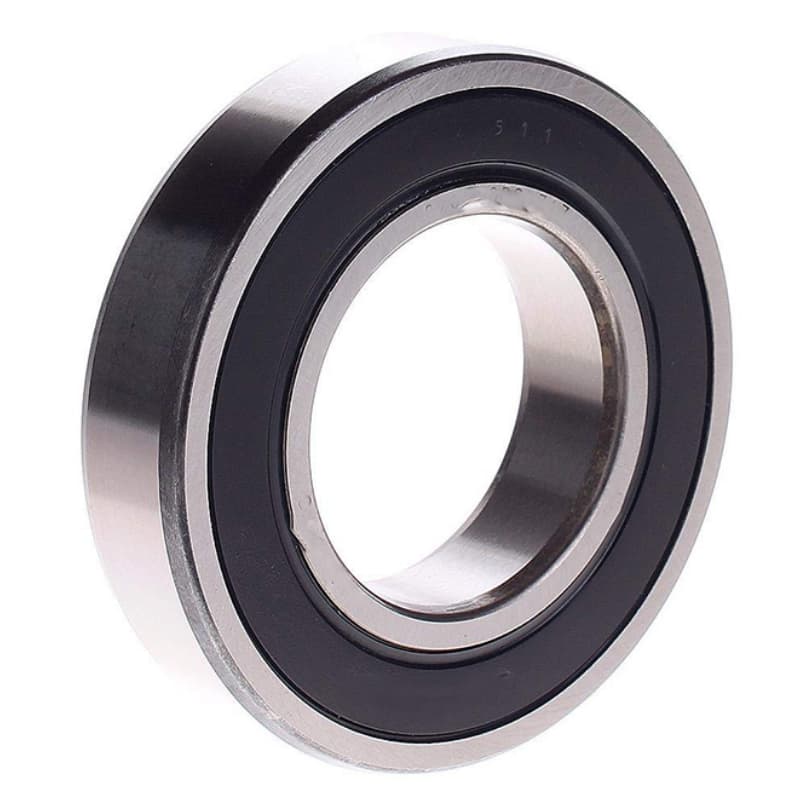
I have supplied bearings to countless belt-driven machines. Fans, conveyors, pumps, compressors. The belt is always the hidden killer. Let me walk you through what works and what fails.
Why Belt Drive Systems Put Extra Stress on Deep Groove Ball Bearings?
A belt does not just turn the shaft. It also pulls on the shaft with a force you cannot ignore.
Belt drives create high radial loads1 because the belt tension2 pulls the shaft sideways. This load is often two to three times higher than the torque load. The bearing must handle that constant pull plus any misalignment from pulley errors.
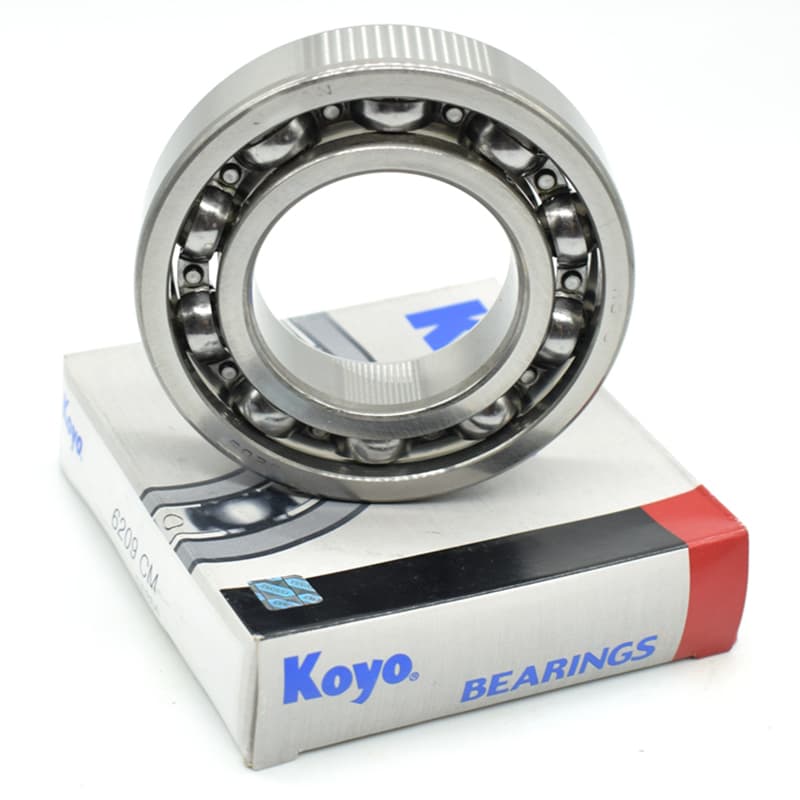
The Hidden Force You Forget
Most engineers calculate the power and speed. They forget the belt tension. That is a big mistake.
When you tighten a V-belt or a flat belt, you put a pre-tension on the shaft. That tension stays there even when the machine is off. For a typical industrial motor, the belt tension can be 500N to 2000N. That is a huge radial load pushing down on the bearing.
Let me give you a real number. A 5kW motor running at 1500 RPM with a V-belt drive. The belt tension is about 800N. The radial load from the belt is 800N. The load from the motor’s own rotor weight is maybe 100N. So the belt is responsible for almost 90% of the total radial load on the bearing.
I learned this from a fan manufacturer in Turkey. They kept replacing bearings every three months. The fans were balanced. The motors were new. The problem was belt tension. They tightened the belts too much. The bearings were overloaded by 40% above their Cr rating. We reduced belt tension to the manufacturer’s spec. The bearings lasted two years.
Three Ways Belt Drives Damage Bearings
Here is a table I share with all my distributor customers.
| Problem | Cause | Damage to Bearing |
|---|---|---|
| Excessive radial load3 | Belt too tight | Inner ring fatigue, ball spalling, short life |
| Misalignment | Pulleys not aligned | Uneven load on one side of raceway, cage wear |
| Heat from belt slippage | Loose belt or wrong profile | Grease breakdown, thermal expansion, reduced clearance |
I saw all three in one factory in India. They made textile spinning machines. The belts were too tight (problem 1). The pulleys were 2mm off (problem 2). The belts slipped and got hot (problem 3). The bearings failed in two weeks. We fixed the pulleys, adjusted belt tension, and used a C3 clearance bearing. Problem solved.
Why Deep Groove Ball Bearings Are Still the Right Choice
You might think a belt drive needs a different bearing type. But deep groove ball bearings are actually very good for this job. They handle high radial loads well. They run at high speeds. They are cheap and easy to find.
The key is choosing the right size and internal design. A 6204 bearing (20mm bore) has a Cr of about 12,800N. That is enough for most belt drives under 10kW. For bigger loads, go up to 6205 or 6305.
I always tell my customers: "Do not under-size the bearing just to save $2. The belt will kill it."
Key Bearing Features to Handle Belt Tension and Misalignment?
Not every deep groove ball bearing works well with belt drives. You need specific features.
Look for a bearing with C3 internal clearance1, a pressed steel or polyamide cage, and a higher radial internal play. For misaligned belt drives, choose a bearing with a spherical outside diameter or use a self-aligning ball bearing2 instead.
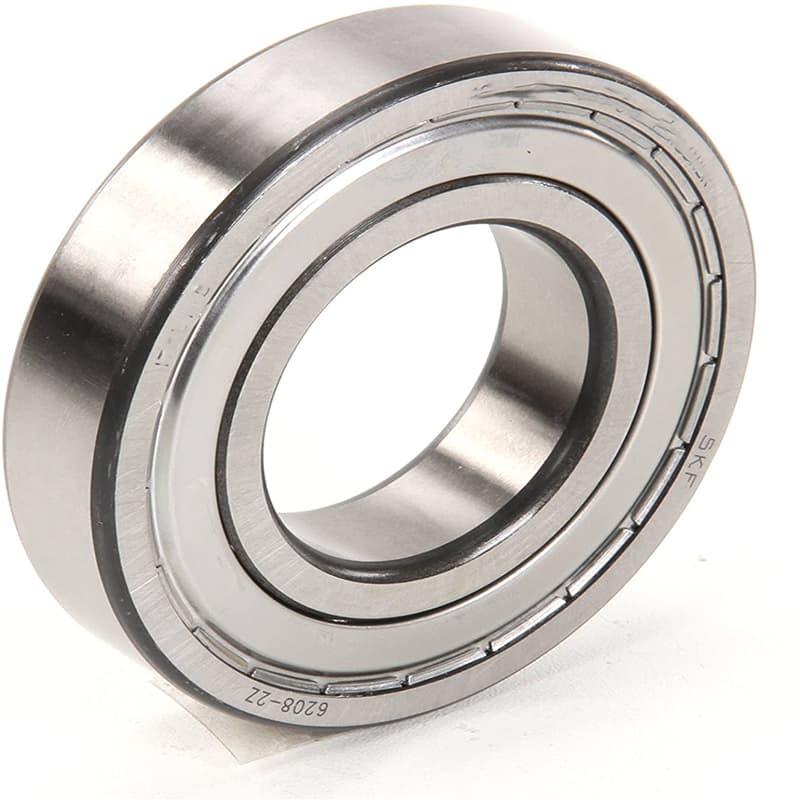
The C3 Clearance Advantage
Standard bearings have CN (normal) internal clearance. That means the balls have a small gap inside the raceway. When the bearing heats up, the gap closes. If it closes too much, the bearing seizes.
Belt drives get hot. The belt slips a little. The friction heats the shaft. The shaft expands. The bearing inner ring expands. The gap gets smaller.
C3 clearance gives you an extra 0.010mm to 0.020mm of internal space. That small difference saves the bearing from seizing.
I tested this in my own factory. Two identical fans with belt drives. One with CN bearing. One with C3 bearing. After 4 hours of running, the CN bearing was 15°C hotter. The C3 bearing ran cooler and quieter.
Cage Material Matters More Than You Think
The cage holds the balls apart. Belt drives create vibration. Vibration shakes the cage.
| Cage Material | Strength | Heat Resistance | Best For |
|---|---|---|---|
| Pressed steel | Very strong | High (up to 300°C) | High speed, high load, dirty environments |
| Polyamide (nylon) | Medium | Low (up to 120°C) | Quiet running, clean environments, low cost |
| Brass | Very strong | Very high (up to 350°C) | Heavy duty, high temperature, expensive |
For belt-driven machinery, I recommend pressed steel cage3s for most industrial applications. They handle vibration better than polyamide. Polyamide cages can crack from the constant shaking of a belt drive.
I had a customer in Egypt with a rock crusher. The belt drive was huge. They used polyamide cage bearings. The cages cracked after three months. We switched to steel cage bearings. No more cracks.
What About Misalignment?
Belt drives often have misalignment. The motor pulley is not perfectly aligned with the machine pulley. That misalignment forces the bearing to tilt.
A standard deep groove ball bearing can handle only 0.001 radian of misalignment (about 0.06 degrees). That is almost nothing.
If your belt drive has more misalignment than that, you have two choices.
-
Fix the alignment. Use a laser alignment tool. Get it under 0.05mm per 100mm.
-
Use a self-aligning ball bearing (1200 series or 2200 series). These bearings have a spherical outer ring. They can handle 2 to 3 degrees of misalignment. But they have lower load capacity.
I always tell my customers to fix the alignment first. A self-aligning bearing is a band-aid, not a cure.
How to Calculate Radial Load from Belt Tension for Bearing Selection?
You can guess the belt tension1. Or you can calculate it. The calculation is not hard.
The radial load2 from belt tension equals 2 x belt tension x (number of belts) x a factor for the wrap angle. For a typical two-belt V-drive with 180° wrap, the radial load is about 1.5 times the belt tension per belt. Use this number to compare with the bearing’s Cr rating.
[^3]](https://sdycbearing.com/wp-content/uploads/2025/12/Deep-Groove-Ball-Bearing-90.jpg)
A Simple Step-by-Step Method
I will show you the method I use for my customers. No advanced math. Just simple numbers.
Step 1: Find the belt tension per belt.
For V-belts, the manufacturer gives a tension range. For a typical SPZ or A-section belt, the tension is between 200N and 400N per belt. For a bigger belt like SPC or C-section, it is 600N to 1200N.
Step 2: Multiply by the number of belts.
If you have two belts, and each belt has 300N tension, the total belt tension is 600N.
Step 3: Apply the wrap angle factor4.
The belt pulls on the shaft. But the direction of the pull changes depending on how much of the pulley is wrapped by the belt.
| Wrap Angle | Factor |
|---|---|
| 180° (full half) | 1.5 |
| 160° | 1.4 |
| 120° | 1.2 |
| 90° | 1.0 |
So for a 180° wrap, the radial load on the bearing = total belt tension x 1.5.
Example: Two belts at 300N each = 600N total tension. Multiply by 1.5 = 900N radial load.
Step 4: Add the rotor weight.
The shaft and pulley also weigh something. Add another 50N to 200N depending on size.
Total radial load = 900N + 100N = 1000N.
Compare with Bearing Cr Rating
Now take that total radial load. Compare it to the Cr rating of your bearing.
For a 6204 bearing (Cr = 12,800N), 1000N is only 8% of Cr. That is very safe. The bearing will last a long time.
But if you had a belt tension of 800N per belt with two belts, total tension 1600N. Wrap factor 1.5 gives 2400N. Add rotor weight 200N = 2600N. That is 20% of Cr. Still safe.
The danger starts when your radial load exceeds 50% of Cr. At that point, the bearing life drops fast.
A Real Example from a Customer
A customer in Vietnam made wood chippers. The belt drive had three B-section belts. Each belt tension was 600N. Total tension = 1800N. Wrap angle was 160° (factor 1.4). Radial load = 1800 x 1.4 = 2520N. Plus rotor weight 300N = 2820N.
They were using a 6206 bearing (Cr = 19,500N). 2820N is 14% of Cr. That is fine. But the bearings failed anyway.
Why? Because the wood chipper had shock loads5. Every time a big log entered, the belt tension spiked to 2000N per belt. The peak radial load was over 9000N. That is 46% of Cr. Still safe, but the repeated shocks caused fretting.
We moved to a 6306 bearing (Cr = 29,000N). The peak load became 31% of Cr. The bearings lasted three times longer.
The lesson: always think about peak loads, not just average loads.
Single Row vs. Double Row Deep Groove Bearings for Belt Applications?
Single row bearings are the standard. Double row bearings are stronger but bigger. When should you choose one over the other?
Single row deep groove ball bearings1 work for most belt drives with radial loads under 50% of Cr. Double row bearings (series 3200 or 3300) handle higher radial loads and some misalignment, but they cost more and need more space. Choose double row when the belt tension is very high or the shaft is short and stiff.
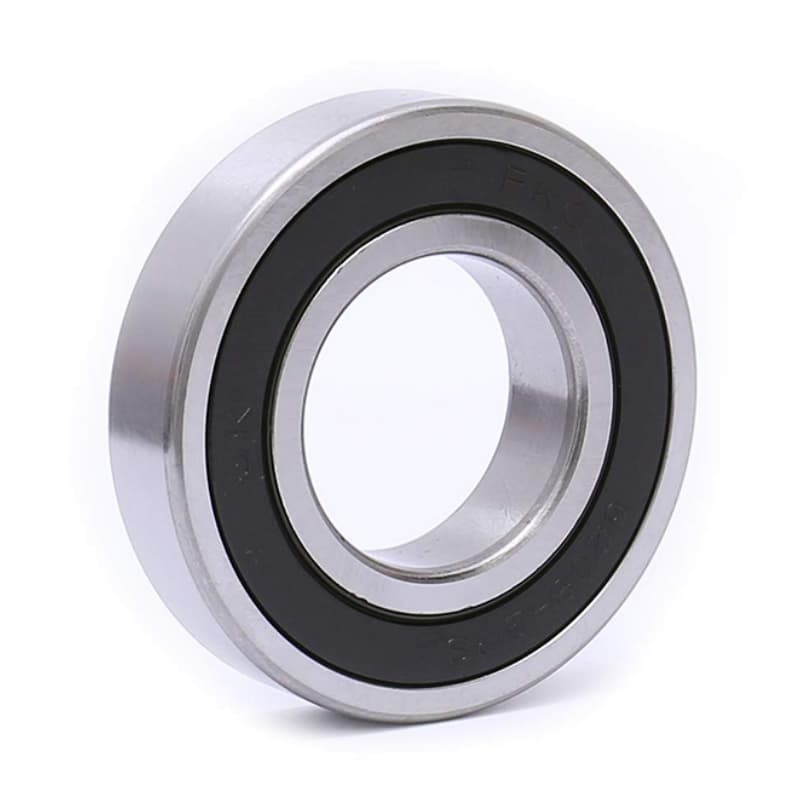
Single Row: The Workhorse
Single row deep groove ball bearings (6200, 6300, 6400 series) are the most common bearings in the world. They are cheap. They are easy to find. They work well for 90% of belt-driven machines.
Here is when I recommend single row:
- Belt tension radial load is less than 50% of Cr
- Shaft speed is over 1000 RPM
- You have space for a normal width bearing
- Cost is important
For example, a fan with a 5kW motor and two A-section belts. Total radial load around 1000N. A 6204 single row bearing (Cr 12,800N) is perfect.
Double Row: The Heavy Lifter
Double row deep groove ball bearings2 have two rows of balls in one housing. They are wider and heavier. Their Cr rating3 is about 60% higher than a single row bearing of the same bore size.
Here is a comparison for 20mm bore bearings.
| Bearing | Type | Width (mm) | Cr (N) | Relative Cost |
|---|---|---|---|---|
| 6204 | Single row | 14 | 12,800 | 1x |
| 3204 | Double row | 20.6 | 20,000 | 1.8x |
| 3304 | Double row (wider) | 22.2 | 22,500 | 2.1x |
When should you pay extra for double row?
- Your radial load exceeds 60% of Cr for a single row
- The shaft is short and cannot take a bigger bore size
- You have some misalignment (double row handles tilt better)
- The machine runs 24/7 and cannot afford downtime
I had a customer in Brazil with a heavy conveyor. The belt tension was 4000N radial load. A 6208 single row (Cr 29,100N) would work. But 4000N is 14% of Cr. So why double row? Because the shaft was only 40mm diameter and very short. A 6308 single row (Cr 40,500N) would be fine, but it needed a wider housing. The customer had no space. So we used a 3208 double row (Cr 38,000N) in the same housing width as a 6208. That solved the problem.
A Common Mistake
Some buyers think double row is always better. That is not true. Double row bearings have higher friction. They run hotter. They need more grease. And they are less forgiving of misalignment than a self-aligning bearing4.
For high speed belt drives5 (over 3000 RPM), a single row bearing with C3 clearance is often better than a double row. The lower friction keeps the temperature down.
I learned this from a spindle manufacturer in Turkey. They tried double row bearings on a belt-driven high speed spindle. The spindle overheated. They switched back to single row with a special cage. Problem fixed.
So my advice: use single row unless you really need the extra load capacity. And if you need misalignment help, use a self-aligning bearing, not a double row.
Conclusion
Choose deep groove ball bearings for belt drives by calculating radial load from belt tension, selecting C3 clearance and steel cages, and using single row for most cases or double row for heavy loads.
-
Explore the benefits of single row deep groove ball bearings, which are cost-effective and suitable for most applications. ↩ ↩ ↩ ↩
-
Learn when to opt for double row deep groove ball bearings, especially for high radial loads and misalignment. ↩ ↩ ↩ ↩
-
Discover the significance of Cr rating in bearings, which helps in selecting the right bearing for your application. ↩ ↩ ↩
-
Find out how self-aligning bearings can solve misalignment issues effectively, enhancing machine reliability. ↩ ↩
-
Investigate the best bearing options for high speed belt drives to prevent overheating and ensure efficiency. ↩ ↩
