
Your packaging line runs at high speed. The labels must be perfect. But your bearings make noise and cause jams.
Compact packaging and labeling machines need pillow block bearings that are small, precise, quiet, and corrosion-resistant. Choose stainless steel housings, high-precision inserts (P5 or better), and contact seals. The right bearings keep your line running smoothly.

I have supplied bearings to packaging equipment makers in Turkey, India, and Brazil. Let me help you pick the right ones. You will get longer life and better label accuracy.
Why Do Compact Packaging Machines Require Specialized Pillow Block Bearings?
Packaging machines are not like conveyors. They run fast, stop often, and need high accuracy. Ordinary bearings cause problems.
Compact packaging machines need specialized pillow block bearings because they operate at high speeds1 (up to 10,000 rpm), have limited space, and require low noise and zero play. Standard bearings are too large, too loose, or too noisy for these applications.
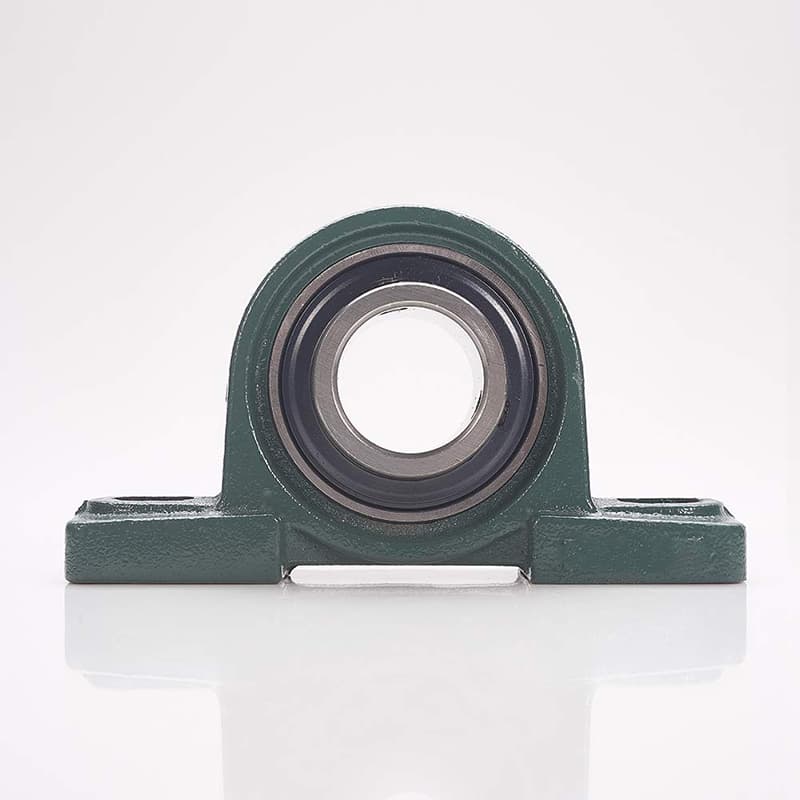
[^2] for packaging machines](https://sdycbearing.com/wp-content/uploads/2025/12/Pillow-Block-Bearing-1.webp)
The Space Constraint
Packaging and labeling machines are compact. Every millimeter matters. You cannot use a large, heavy-duty pillow block. You need a small, lightweight unit.
Standard pillow blocks have thick housings and large footprints. Specialized compact pillow blocks have thinner walls and smaller center heights. They fit into tight spaces.
I had a customer in India who built labeling machines. He used standard pillow blocks. They were too tall. He had to raise the whole frame. He switched to our compact series pillow blocks. The height was 20% lower. He saved space and material costs.
High Speed and Frequent Starts
Labeling machines run at high speeds. A labeling head might spin at 5,000 to 10,000 rpm. The bearings must handle that speed without overheating.
Also, packaging machines start and stop many times per minute. Each start puts stress on the bearing and the grease. The grease film gets squeezed out during the stop. The next start happens with less lubrication. This is called boundary lubrication. It wears bearings faster.
Standard pillow block bearings are designed for continuous running at moderate speeds (under 3,000 rpm). They fail fast in high-speed, start-stop applications.
Here is a comparison of typical packaging machine conditions vs standard bearings:
| Parameter | Packaging Machine | Standard Bearing Capability | Issue |
|---|---|---|---|
| Speed | 5,000 – 10,000 rpm | 3,000 – 5,000 rpm | Overheating, grease failure |
| Start-stop frequency | 20-60 per minute | 5-10 per minute | Grease starvation, wear |
| Required runout | <0.01 mm | 0.02-0.05 mm | Poor label placement |
| Noise level | <55 dB | 60-70 dB | Unacceptable in clean rooms |
Precision – The Label Quality Factor
A labeling machine must place a label within 0.5 mm accuracy. If the bearing has play or runout, the label will be crooked. That means rejected products.
Standard pillow block bearings have P0 precision2 (normal). The runout can be 0.02-0.05 mm. That is too much for high-speed labeling. You need P5 or P6 precision with runout under 0.01 mm.
I remember a customer in Brazil who made pharmaceutical labelers. His labels were sometimes off by 1 mm. He checked everything. The problem was the pillow block bearings. They had too much radial play. We replaced them with P5 precision units. The labels became perfect.
So specialized bearings are not a luxury. They are a necessity for modern packaging lines.
What Speed and Precision Ratings Matter Most for Labeling Machine Bearings?
You cannot guess the right bearing. You need to look at two numbers: speed rating and precision grade1. These decide if your machine works or fails.
For labeling machine bearings, the most important ratings are the limiting speed3 (grease-lubricated) and the precision grade (P5 or P6). The speed rating must exceed your machine’s maximum rpm by 20%. The precision grade determines label placement accuracy.
Limiting Speed – Don’t Exceed It
Every bearing has a limiting speed. This is the maximum rpm it can handle with a given lubrication. Exceed this speed, and the bearing will overheat. The grease will break down. The bearing will seize.
For pillow block bearings, the limiting speed is usually lower than for bare bearings because the housing traps heat.
Here is a typical speed table for compact pillow blocks (bearing insert size 6204):
| Seal Type | Limiting Speed (grease) | Max for Labeling |
|---|---|---|
| Open (no seals) | 12,000 rpm | Not used (dust gets in) |
| ZZ (metal shields) | 10,000 rpm | Possible for clean rooms |
| 2RS (rubber seals) | 6,000 rpm | Good for most |
| 2RS with low-friction seals | 8,000 rpm | Best for high-speed |
For labeling machines running at 8,000 rpm, you need a bearing with a limiting speed of at least 9,600 rpm (20% margin). That means you cannot use standard 2RS seals2. You need ZZ or special low-friction seals.
I had a customer in Turkey with a high-speed labeler running at 9,000 rpm. He used 2RS bearings. They failed in 2 weeks from heat. We switched to ZZ bearings4 with metal shields. They ran cool and lasted 2 years. The environment was clean, so dust was not a problem.
Precision Grade – P0, P6, P5, or P4?
Bearings come in different precision grades. The grade tells you how round the bearing is and how tight the tolerances are.
| Grade | Runout (max) | Typical Use | Cost Multiplier |
|---|---|---|---|
| P0 (normal) | 0.02-0.05 mm | Conveyors, fans | 1.0x |
| P6 | 0.01-0.02 mm | General industrial | 1.3x |
| P5 | 0.005-0.01 mm | Machine tools, packaging | 1.8x |
| P4 | 0.002-0.005 mm | Spindles, precision | 3.0x+ |
For labeling machines, P5 is usually the right choice. It gives you runout under 0.01 mm. That is enough for accurate label placement. P4 is overkill and too expensive.
I supplied P5 bearings to a medical device labeler in Vietnam. The machine placed labels on small vials. The tolerance was 0.2 mm. P0 bearings caused 0.5 mm variation. P5 bearings reduced variation to 0.1 mm. The customer was happy.
How to Read a Bearing Number for Precision
A standard bearing number like 6204-2RS means P0 precision. If you want P5, it is written as 6204-2RS/P5. The /P5 suffix tells the precision grade.
Always ask your supplier for the precision grade. Many cheap bearings claim P5 but are actually P0. Ask for a test report.
The Relationship Between Speed and Precision
Higher precision bearings also run smoother at high speeds. The balls and raceways are rounder. There is less vibration. That means less heat and longer life.
For a labeling machine running over 6,000 rpm, I recommend:
- P5 precision grade
- ZZ metal shields (or special low-friction seals)
- Polyurea grease for high speed
This combination will give you accurate labels and long bearing life.
How to Choose Corrosion-Resistant Bearings for Food and Pharma Packaging Lines?
Food and pharmaceutical packaging lines get washed with chemicals. The bearings must survive. Standard steel bearings will rust fast.
For food and pharma packaging lines, choose pillow block bearings with 316 stainless steel1 housings and inserts, FKM (Viton) seals3, and NSF H1 food-grade grease2. This combination resists caustic washdowns, acids, and detergents. It also meets FDA and EU regulations.
The Washdown Challenge
Food and pharma lines are washed daily – sometimes every shift. The washdown uses hot water (60-80°C), chlorine, peracetic acid, or caustic soda. These chemicals attack standard bearings.
A customer in a meat packing plant in Brazil used standard cast iron pillow blocks. After 2 months, the housings were covered in rust. The bearings seized. He switched to all-stainless bearings. The problem stopped.
Materials That Survive
Here is what you need for food and pharma washdown:
Housing: 316 stainless steel. Not 304. 304 can rust from chlorides. 316 has molybdenum for extra protection.
Bearing insert: 316 stainless for light loads. For heavier loads, use 440C stainless with a special coating. Or use hybrid bearings with ceramic balls4.
Seals: FKM (Viton) rubber. Standard NBR hardens from hot water and chemicals. FKM stays flexible.
Grease: NSF H1 food-grade. This is safe for incidental food contact. It also resists water washout. Choose a grease with calcium sulfonate thickener5.
Here is a material suitability table for common washdown chemicals6:
| Chemical | Standard Cast Iron | 304 Stainless | 316 Stainless | NBR Seal | FKM Seal |
|---|---|---|---|---|---|
| Hot water (80°C) | Rusts | OK | OK | Hardens | OK |
| Chlorine (100 ppm) | Severe rust | Pits | OK | Degrades | OK |
| Peracetic acid | Severe rust | Pits | OK | Degrades | OK |
| Caustic soda (pH 12) | Rusts | OK | OK | OK | OK |
| Salt water | Severe rust | Pits | OK | OK | OK |
Food-Grade Grease – Not Optional
You cannot use standard grease in food or pharma packaging. It might contaminate the product. You must use NSF H1 registered grease.
But not all H1 greases are the same. For washdown, look for:
- Water resistance rating (ASTM D1264) – less than 10% loss
- Base oil viscosity – ISO VG 150-220
- Thickener – aluminum complex or calcium sulfonate
I have used Klüber, Mobil, and Fuchs food-grade greases. They work well. Avoid cheap H1 greases – they wash away quickly.
A Real Example
A customer in Indonesia made bottled water. His labeling machine bearings failed every 3 months from rust. We supplied 316 stainless pillow blocks with FKM seals and NSF H1 calcium sulfonate grease. The bearings lasted 3 years. The cost was higher upfront. But he saved 12 bearing changes and hours of downtime.
So for food and pharma, do not compromise. Go all-stainless with FKM seals and food-grade grease.
Which Bearing Insert Locking Style – Set Screw or Eccentric Collar – Is Best for High-Speed Labeling?
The locking style holds the bearing insert onto the shaft. In high-speed labeling machines1, a loose bearing will cause vibration and inaccurate labels.
For high-speed labeling machines, the eccentric locking collar is better than set screws. The collar provides 360-degree clamping force. It does not create a flat spot on the shaft. Set screws can loosen from vibration and damage the shaft. Eccentric collars stay tight longer.

Set Screw Locking3 – Simple but Flawed
Set screw locking uses one or two screws in the bearing inner ring. You tighten the screws against the shaft. The screws dig into the shaft. This creates a dent.
Problems with set screws at high speed:
- The dent creates an imbalance. At 6,000 rpm, that imbalance causes vibration.
- The screws can loosen from vibration. The bearing slides on the shaft.
- The shaft gets damaged. You cannot reuse it without repair.
I saw a labeling machine in Turkey that used set screw bearings. After 6 months, the screws loosened. The bearing moved on the shaft. The labels became crooked. The customer had to replace the shaft as well as the bearing.
Eccentric Collar Locking2 – Better for High Speed
An eccentric collar has an offset bore. You place the collar over the bearing inner ring. Then you rotate the collar. The offset locks the collar onto the shaft. The clamping force is 360 degrees around the shaft. No dents. No imbalance.
Eccentric collars stay tight under vibration. They also do not damage the shaft. You can remove and reuse the shaft.
For high-speed labeling (over 4,000 rpm), I always recommend eccentric collars.
Comparison Table
| Feature | Set Screw | Eccentric Collar |
|---|---|---|
| Clamping force | Point contact (2-4 points) | 360-degree contact |
| Shaft damage | Yes (dents) | No |
| Balance at high speed | Poor (unbalanced) | Good |
| Vibration resistance | Low (screws loosen) | High |
| Ease of installation | Simple (just tighten screws) | Requires rotation of collar |
| Cost | Lower | Slightly higher |
| Best for | Low speed, low vibration | High speed, high vibration |
How to Install an Eccentric Collar Correctly
Many people install eccentric collars wrong. Here is the correct method:
- Slide the bearing onto the shaft.
- Place the collar over the inner ring. The collar has a small eccentric mark.
- Rotate the collar in the direction of shaft rotation until it stops.
- Tap the collar lightly with a punch and hammer – one or two light taps.
- Tighten the set screw on the collar (if present).
Do not hammer hard. Do not use a pipe wrench. The collar should be snug but not forced.
I have seen customers over-tighten eccentric collars. They distort the inner ring. The bearing runs hot and fails. Follow the steps above.
A Recommendation for Labeling Machines
For high-speed labeling machines (over 4,000 rpm), use:
- Eccentric collar locking
- P5 precision bearing4
- Stainless steel housing and insert (for washdown)
For low-speed packaging conveyors (under 1,000 rpm), set screws are fine.
I had a customer in India who built high-speed labelers. He used set screw bearings. The labels were inconsistent at 8,000 rpm. He switched to eccentric collars. The problem went away. The collars cost $2 more per bearing. That was a small price for perfect labels.
Conclusion
For compact packaging and labeling machines, pick compact stainless housings, P5 precision, eccentric collars, and FKM seals. Your labels will be perfect.
-
Discover essential features for high-speed labeling machines to enhance efficiency and accuracy in labeling. ↩ ↩ ↩ ↩
-
Explore the benefits of eccentric collar locking for high-speed applications to ensure optimal performance and reliability. ↩ ↩ ↩ ↩
-
Learn about the drawbacks of set screw locking to understand why it may not be suitable for high-speed machinery. ↩ ↩ ↩
-
Learn about P5 precision bearings and their significance in ensuring high-speed machinery operates smoothly. ↩ ↩ ↩
-
Find out how calcium sulfonate thickener enhances grease performance in food and pharma applications. ↩
-
Understand the types of washdown chemicals and their impact on equipment to ensure proper maintenance. ↩