
A few years ago, I got a call from an OEM customer in Turkey. He designed a new agricultural conveyor. He picked a pillow block bearing from our catalog. He thought it would fit. But when his team installed the first prototype, the bearing housing hit the frame. The shaft was 2mm too small. The whole design had to change. That delay cost him two weeks and a lot of money.
OEM machinery builders must confirm four key technical points when selecting pillow block bearings: shaft diameter and tolerances, housing dimensions and bolt patterns, load ratings and speed limits, and seal configurations for the operating environment. These factors directly affect machine performance and assembly fit.
Let me tell you something honest. Selling bearings to distributors is one thing. They buy standard sizes and sell them to repair shops. But OEM builders are different. They integrate our bearings into their own machines. If we get the technical details wrong, their whole production line stops. That is why I always spend extra time with OEM clients. I ask questions. I check drawings. I confirm every number. In this article, I want to share the four most important points we review with every OEM customer. These are the points that save headaches later.
What Shaft Diameter and Tolerances Should You Specify for Your Design?
I remember a designer from India. He sent me a drawing for a textile machine. He specified a 30mm shaft diameter. But he did not mention the tolerance. We shipped bearings with a standard bore tolerance of 0 to -0.01mm. His shaft was actually 30.05mm. The bearing would not slide on. His team tried to hammer it on. They damaged the bearing. Then they blamed us.
The short answer is that you must specify both the nominal shaft diameter and the fit class. The most common fits are h6, j6, and k6 for the shaft. For pillow block bearings with set screw locking, we usually recommend a j6 or k6 fit. For taper sleeve mounting, you have more flexibility because the sleeve expands.
Let me explain this in detail.
The difference between clearance fit, transition fit, and interference fit
Shaft-to-bearing fits come in three categories. A clearance fit means the shaft is smaller than the bore. The bearing slides on easily. But it can also spin on the shaft under load. That damages the shaft and the bearing. A transition fit means the shaft and bore are almost the same size. You need light pressure to install. An interference fit means the shaft is larger than the bore. You need a press or heat to install it. This fit locks the inner ring to the shaft. It is the most secure.
For pillow block bearings on a conveyor or industrial machine, I usually recommend a transition fit or a light interference fit. The bearing should not rotate on the shaft. But you also do not want to crack the inner ring during installation.
What tolerance classes mean for your design
Tolerance classes are letters and numbers. For example, h6 is a common shaft tolerance. The "h" means the shaft is at the nominal size or smaller. The "6" means the tolerance band. A 30mm h6 shaft has a maximum size of 30.000mm and a minimum of 29.987mm. A 30mm k6 shaft has a maximum of 30.015mm and a minimum of 30.002mm. That is a tighter fit.
Here is a simple guide.
| Shaft Tolerance | Fit Type | Installation Method | Best Application |
|---|---|---|---|
| h6 | Clearance | Hand slide | Low load, low speed, easy assembly |
| j6 | Transition | Light tap with hammer | General industrial use, moderate load |
| k6 | Light interference | Press or heat | High vibration, heavy load, set screw locking |
| m6 | Interference | Press with higher force | High torque, no keyway, permanent assembly |
What we recommend for OEM builders
For most OEM applications, we recommend j6 or k6. These give a secure fit without making installation too hard. We also recommend you specify the surface finish of the shaft. A rough shaft damages the bearing bore. A too-smooth shaft reduces the grip. We suggest Ra 0.8 to 1.6 micrometers for most shafts.
We also check the shaft hardness. If the shaft is soft, the set screw can dent it. That makes removal difficult. We recommend a shaft hardness of at least HRC 40 for set screw locking.
One more point. We check the shaft roundness. An oval shaft creates uneven load in the bearing. The balls do not run smoothly. The bearing noise increases. We recommend roundness within 0.005mm.
So my advice to OEM designers is simple. Do not just write "30mm shaft." Write "30mm k6 shaft, Ra 1.0 finish, HRC 45 minimum." That extra detail saves a lot of trouble.
How Do Housing Dimensions Affect Your Machine’s Bolt Pattern and Footprint?
I once worked with a packaging machine builder. He designed his frame. He welded the mounting brackets. Then he ordered our bearings. He did not check the center height. Our UCP bearing had a center height of 49.2mm. His brackets were designed for 50mm. That 0.8mm difference meant his shaft was not level. The whole machine had to be rewelded.
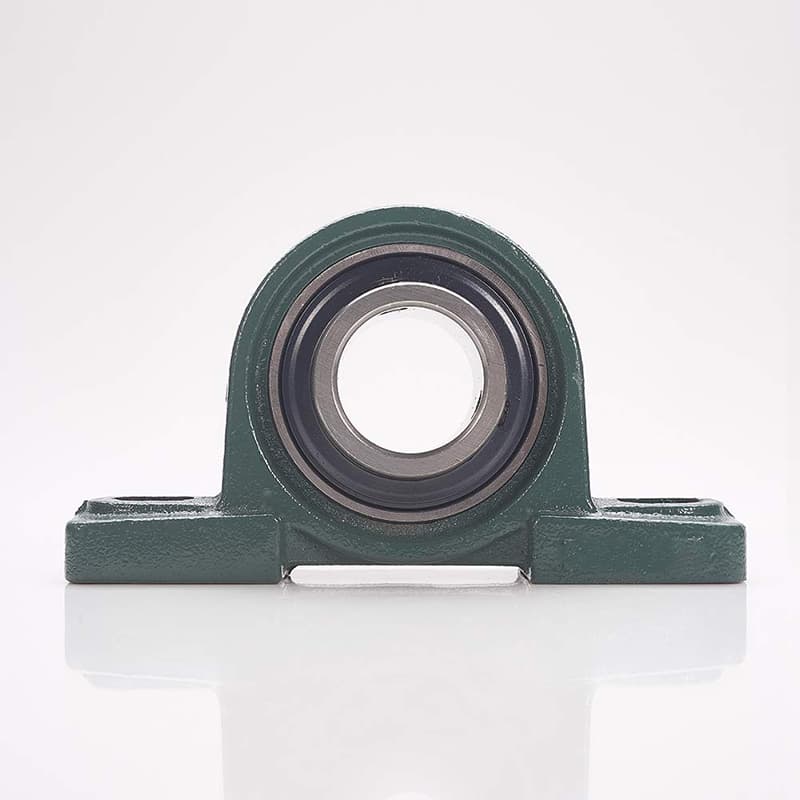
The short answer is that housing dimensions determine your bolt pattern, center height, and overall footprint. Different series like UCP, UCF, and UCFL have different bolt hole spacing and heights. You must confirm these dimensions before you finalize your machine design.
Let me break down what you need to check.
Center height is critical for alignment
Center height is the distance from the base of the housing to the center of the shaft hole. We call it H. For a UCP series, H is fixed for each size. For example, UCP205 has H of 36.5mm. UCP210 has H of 57.2mm. If your machine frame is already welded, you must match this height.
I have seen OEM engineers design their frame before choosing the bearing. That is a mistake. Always choose the bearing first. Then design the frame. Or at least confirm the center height before you cut steel.
Bolt hole spacing and thread size
Each housing has two bolt holes for mounting. The spacing between them is called J. The distance from the edge is called A. These dimensions vary by series. UCP has a wide footprint. UCF has a flanged footprint. UCFL has a diamond shape.
Here is the key point. You must confirm the bolt hole size and thread type. Some housings use through holes. Others use tapped holes. If you design for through holes and get tapped holes, you have to redesign. We have seen this happen. It is not fun.
The footprint affects your machine layout
The footprint is the total space the bearing takes on your machine. It includes the housing base and the space needed for bolts and washers. For OEM builders, this matters because you have other parts nearby. Belts, gears, and covers all need space. A bearing that fits on paper might not fit in the real assembly.
Let me give you a comparison table.
| Series | Mounting Type | Center Height (H) | Bolt Spacing (J) | Best Use |
|---|---|---|---|---|
| UCP | Pillow block (2-bolt) | Standard | Wide | General conveyors, shaft support |
| UCF | Flanged (4-bolt) | Not applicable | Square pattern | Machines with limited vertical space |
| UCFL | Diamond flange (2-bolt) | Not applicable | Narrow | Tight spaces, light loads |
| UCT | Take-up (adjustable) | Variable | Slotted | Belt tensioning, chain drives |
What we do at FYTZ for OEM clients
We always provide a full dimensional drawing with our quotation. The drawing shows H, A, J, and bolt hole diameter. We also mark the tolerance for each dimension. Our standard tolerance is +/- 0.5mm for casting dimensions. For precision applications, we can tighten that to +/- 0.2mm.
We also offer custom housing designs. If your machine needs a special center height or bolt pattern, we can modify the casting. We do this for many OEM clients. We ask them to send their frame drawing. Then we design a housing that fits perfectly. This saves them from redesigning their whole machine.
So my advice is to check every dimension before you order. Do not rely on the bearing size alone. A UCP210 from one brand might have slightly different dimensions from another brand. Always ask for the drawing.
What Load Ratings and Operating Speeds Match Your Specific Application?
I had a customer from Egypt who built grain elevators. He ordered pillow block bearings with a high load rating. He thought bigger was always better. But the bearings he chose had a lower speed limit. His elevator ran at 3000 RPM. The bearing was rated for 2000 RPM. The bearings overheated. The grease melted. The elevators stopped.
The short answer is that you must match the bearing’s dynamic load rating (C) and static load rating (C0) to your machine’s actual load and speed. Selecting only by shaft size ignores the operating conditions that cause failure.
Let me explain this step by step.
Dynamic load rating tells you fatigue life
The dynamic load rating is called C. It is measured in Newtons or kilograms. It represents the load at which the bearing will survive for 1 million revolutions. A higher C means a longer life under the same load.
But here is the catch. Most OEM engineers use the rated load directly. They think a bearing with C=30kN can handle 30kN forever. That is not true. The rated life is only 1 million revolutions. At 1000 RPM, that is about 16 hours. You want a longer life. So you must derate the load. You calculate the actual expected life using a formula. The standard is L10 life. It gives the life that 90% of bearings will exceed.
I always tell my OEM clients to aim for an L10 life of at least 20,000 hours. For critical machines, we aim for 50,000 hours.
Static load rating prevents permanent deformation
The static load rating is called C0. It is the load that causes permanent deformation of 0.0001 times the ball diameter. This matters for machines with heavy starts and stops, or for machines that sit under load while not running.
If your conveyor holds a heavy load while stopped, the static load might exceed C0. That damages the raceway. The bearing becomes noisy. It fails prematurely.
Speed limits depend on grease, seal, and internal design
Every bearing has a speed limit. It is usually given as RPM. But this limit is not fixed. It depends on the grease type, the seal type, and the operating temperature.
Open bearings run faster than sealed bearings. Grease with high viscosity runs slower but handles higher temperatures. Synthetic grease runs faster than mineral grease.
Here is a simple guide.
| Condition | Speed Factor | Example for UCP210 |
|---|---|---|
| Grease lubrication, standard seal | 1.0 (base) | 2,500 RPM |
| Grease lubrication, open (no seal) | 1.3x | 3,250 RPM |
| Oil lubrication | 1.5x | 3,750 RPM |
| High-temperature grease (>120°C) | 0.7x | 1,750 RPM |
What we recommend for OEM builders
We recommend you calculate your actual bearing load. Include the weight of the shaft, the belt tension, and the impact load. Add a safety factor of at least 1.5. Then compare that to the C and C0 ratings in our catalog.
We also recommend you check the speed. If your machine runs above 2000 RPM, consider open bearings with oil lubrication. If it runs below 500 RPM, you can use sealed bearings with heavy grease.
One more tip. We test our bearings for noise and vibration. We have a laboratory that measures dBa levels. For OEM machines that need low noise, we recommend our P5 or P6 precision grades. These have better internal geometry. They run quieter and smoother.
So my advice is to send us your actual operating data. Tell us the load, speed, temperature, and duty cycle. We will recommend the exact bearing model. Do not guess. Guessing leads to over-design or under-design. Both cost you money.
Which Seal Configuration Best Protects Your Machine in Its Intended Environment?
A customer from Russia ordered pillow block bearings for an outdoor conveyor. He chose standard seals. His conveyor ran through snow, mud, and salt spray. The seals failed in one month. Water got inside. The bearings froze solid in the winter.
The short answer is that seal configuration depends on your machine’s operating environment. Standard seals work for clean, dry conditions. For dust, moisture, or high-pressure washdown, you need upgraded seals like triple-lip, labyrinth seals, or V-rings.
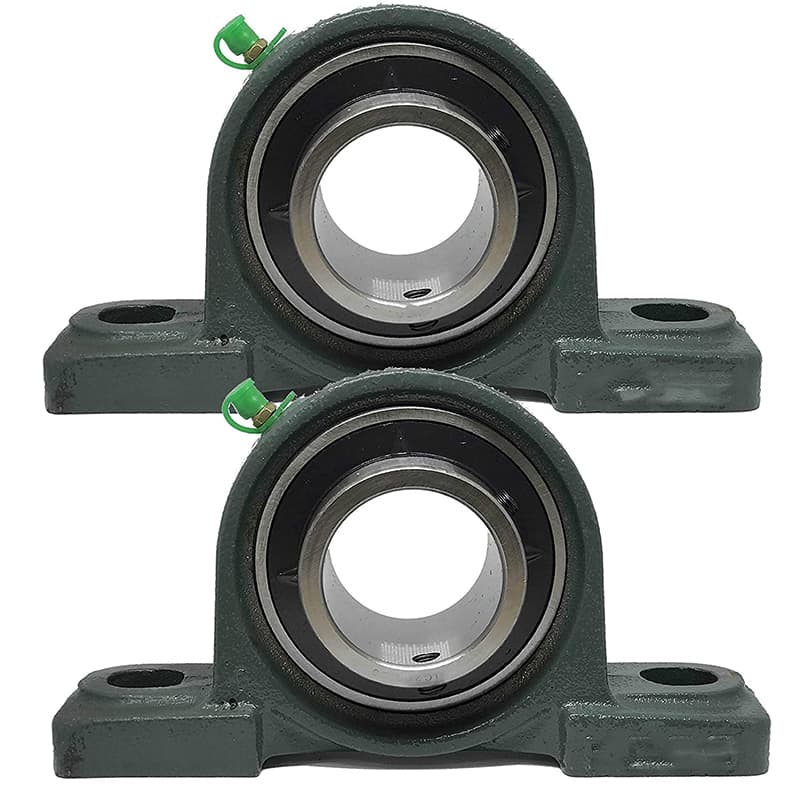
Let me go through the options.
Standard single-lip seals
Single-lip seals are basic. They have one rubber lip that touches the shaft. They keep out dust and light splash. They are cheap. They work for 80% of applications.
But they have limitations. If the shaft is worn, the lip does not seal well. If the pressure is high, the lip leaks. If the dust is fine, it gets past the lip.
Double-lip or triple-lip seals
These have two or three rubber lips on the shaft. Each lip adds a barrier. The space between the lips holds a small amount of grease. That grease traps dust and forms a seal.
We use triple-lip seals for most recycling and mining applications. They handle heavy dust. They also resist water spray. The extra lips cost more, but they extend bearing life significantly.
Labyrinth seals
Labyrinth seals do not touch the shaft. They have a long, twisting path. Dust and water have to travel through that path. The path is so long that contaminants get trapped before they reach the bearing.
Labyrinth seals are excellent for high-speed applications. They create no friction. They also run cooler than rubber seals. However, they need a clean shaft. If the shaft is rough, the labyrinth does not work well.
V-rings and flinger seals
V-rings are rubber rings that mount on the shaft. They spin with the shaft. Their shape flings away dust and water like a centrifuge. They work as an extra defense in front of the main seal.
We often pair V-rings with standard seals for outdoor machines. The V-ring handles the heavy dirt. The standard seal handles the rest.
Here is a selection guide
| Environment | Recommended Seal | Additional Protection |
|---|---|---|
| Clean, indoor, low dust | Single-lip | None needed |
| Moderate dust, some moisture | Double-lip | Grease nipple for purging |
| Heavy dust, wet, outdoor | Triple-lip or labyrinth | V-ring on shaft |
| High-pressure washdown | Labyrinth with stainless housing | Grease purge every shift |
| High temperature (>100°C) | Labyrinth | High-temperature grease |
What we do for OEM clients
We always ask about the operating environment. We ask if the machine runs indoors or outdoors. We ask about washdown cycles. We ask about ambient temperature. We ask about the type of dust.
If the OEM builder is unsure, we offer to test the seal. We can run a seal test in our lab. We simulate dust and water spray. We measure how much contaminant gets through. This data helps us choose the right seal.
One of our OEM clients in South Africa builds mining conveyors. They were using standard seals. They had failures every two months. We switched them to triple-lip with a V-ring. Now they get 12 months of operation. That is a huge improvement.
So my advice is to describe your environment in detail. Tell us what the bearing will face. Do not hide the tough conditions. We design better seals when we know the real challenge.
Conclusion
OEM machinery builders need to confirm shaft tolerances, housing dimensions, load and speed ratings, and seal configurations before ordering pillow block bearings. Get these four points right, and your machine will run reliably for years.