
Your machine stops because a bearing broke. That costs you money and time. You need a bearing that can take the pressure.
Yes, the right bearing gives you maximum load capacity. You just need to check three things: the bearing type, the internal design, and the material. Choose wisely, and your machine will run heavier loads without failing.
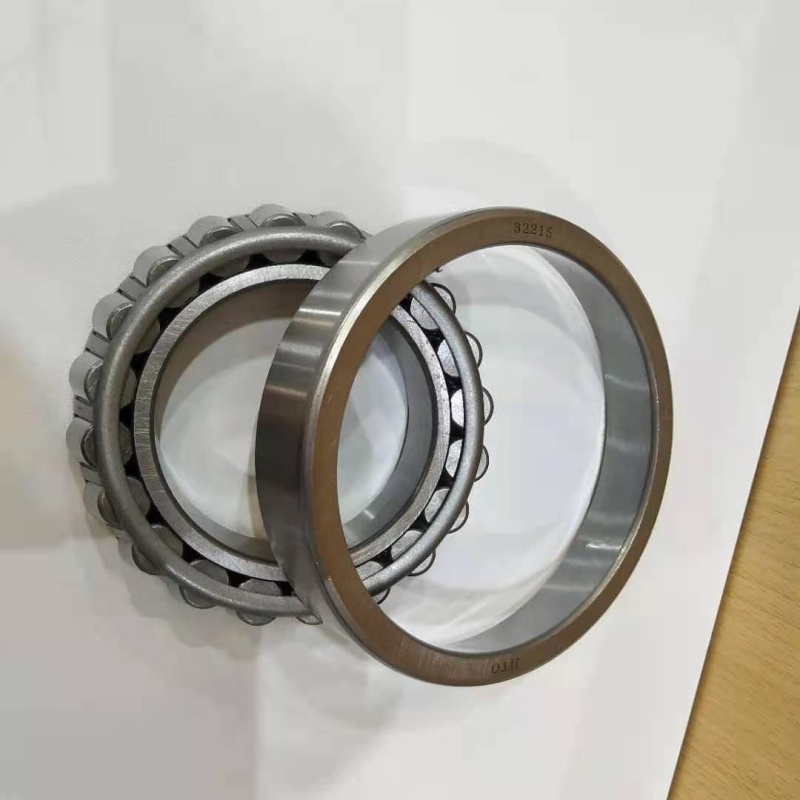
I run a bearing factory called FYTZ Bearing in China. We make deep groove ball bearings, taper roller bearings, pillow block bearings, and many other types. Every week, I get calls from procurement managers like Rajesh from India. They ask me: "How do I get a bearing that won’t break under heavy loads?" The answer is not just one bearing. It depends on your machine. In this post, I will explain what gives a bearing high load capacity. I will compare deep groove and taper roller bearings. I will show you how to match load ratings to your needs. And I will share real stories from my customers. Keep reading.
What Core Factors Determine a Bearing’s Load Capacity?
Most buyers think a bigger bearing always carries more load. That is not true. A small bearing with the right design can beat a big bearing with a poor design.
Three core factors decide load capacity: the number and size of rolling elements, the internal clearance, and the material hardness. More rolling elements mean the load spreads out. Less internal clearance means less play. Harder material means less denting under pressure.
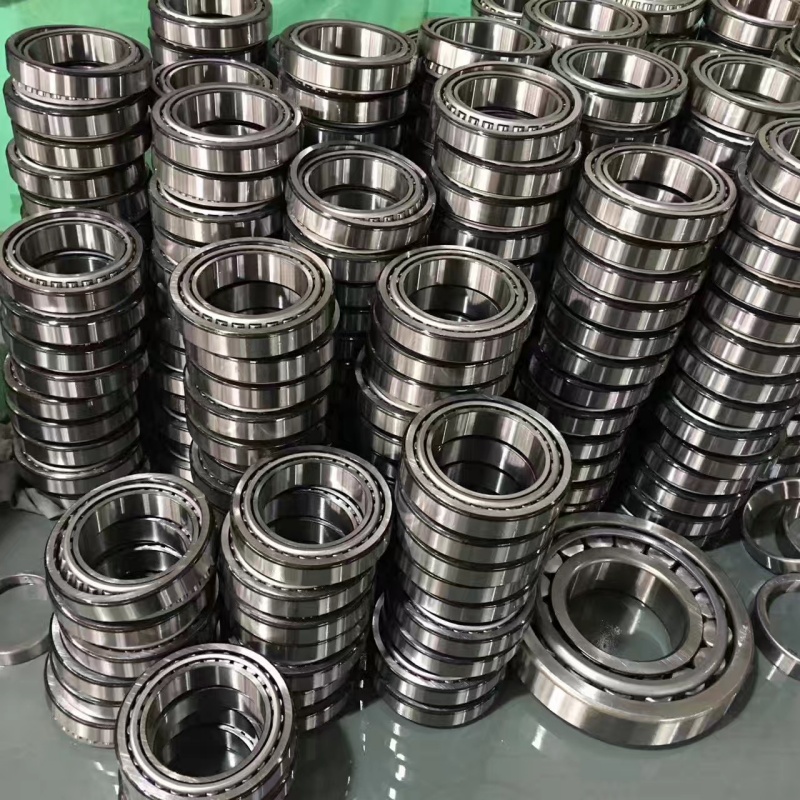
Let me break these three factors down one by one.
First, the rolling elements. Every bearing has balls or rollers inside. The more elements you pack in, the less weight each one carries. But you cannot just add more. There is a trade-off. If you put too many, they rub against each other. That creates heat. So a good high-load bearing uses a design called “full complement”. That means no cage. The rollers sit right next to each other. You get more rollers in the same space. But the max speed goes down. So full complement bearings work great for slow, heavy machines like presses or conveyor rollers.
Second, internal clearance. This is the small gap between the rolling elements and the raceways. For heavy loads, you want a smaller gap. Why? Because when you put a heavy load on the bearing, the gap closes. If the gap is too big, the rolling elements shift. Then they hit the raceway at an angle. That causes stress points and early failure. So for heavy loads, I always recommend a “C3” clearance or even “C4” for very heavy shocks. C3 means a little extra room for heat expansion. But do not go too big. I have seen customers order C4 for normal loads. The bearing felt loose and noisy.
Third, material hardness. Most bearings use chrome steel (GCr15). That steel is hard – about 60-65 HRC. Hard steel resists indentation. When a heavy load presses down, a soft bearing would get little dents on the raceway. Those dents grow into cracks. Hard steel prevents that. At FYTZ, we use vacuum-degassed steel. That means fewer impurities. The result is a bearing that can take higher loads without failing early.
Here is a quick table to show how these factors change load capacity:
| Factor | Low Load Capacity | High Load Capacity | What To Look For |
|---|---|---|---|
| Rolling elements | Few, with cage | Many, full complement | Count the rollers |
| Internal clearance | CN (normal) | C3 or C4 | Marked on the box |
| Material hardness | Below 58 HRC | 60-65 HRC, vacuum degassed | Ask for test report |
| Raceway finish | Rough, 0.3 Ra | Smooth, 0.1 Ra | Look for shiny surface |
So when you buy bearings, do not just look at the size. Ask the supplier about these three factors. I give this information to all my clients who call me at +86 150 2064 2375.
Deep Groove vs. Taper Roller Bearings: Which Type Handles Heavy Loads Better?
I get this question a lot. Both types can carry heavy loads. But they do it in different ways. And each one has a limit you need to know.
Deep groove ball bearings handle heavy radial loads but not heavy axial loads. Taper roller bearings handle both radial and axial loads together. For pure radial weight, a deep groove bearing works fine. For combined loads, choose taper roller.
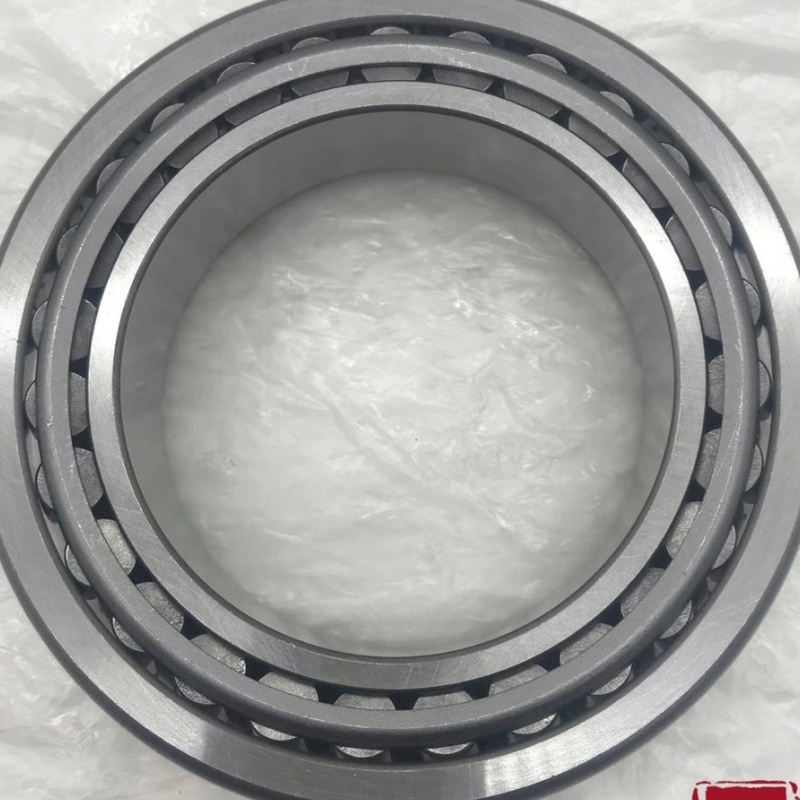
How do these two designs work? And where does each one fail?
Let me start with deep groove ball bearings. These are the most common bearings in the world. They have a simple design: an inner ring, an outer ring, and a set of steel balls in a cage. The groove is deep – deeper than a standard ball bearing. That means the balls sit deep inside the raceway. So when a heavy radial load pushes down, the balls cannot pop out. The load spreads over several balls. This works great for radial loads like a heavy spinning drum or a conveyor roller.
But deep groove bearings have a weakness. They do not like axial (thrust) loads. You can put a little axial load, maybe 30% of the radial rating. More than that, and the balls push against the edge of the groove. That creates heat and wear. I had a customer in Indonesia who used deep groove bearings on a fan with a heavy side load. The bearings failed every two weeks. We switched to taper rollers, and the problem went away.
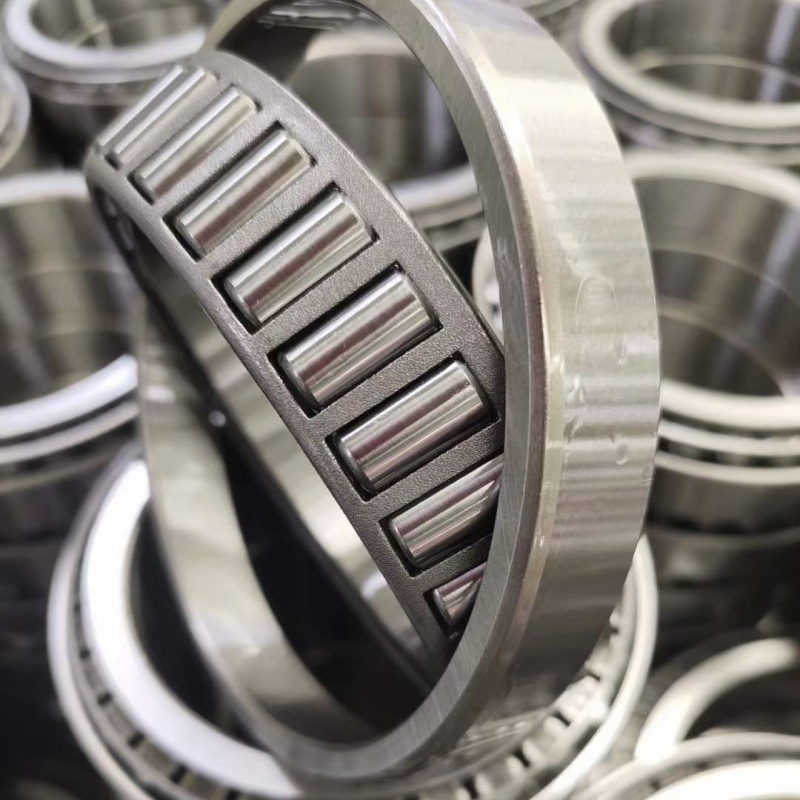
Now let me talk about taper roller bearings. These have tapered inner and outer raceways. The rollers are also tapered, like a small cone. This design lets the bearing take both radial and axial loads at the same time. The load passes from the roller to the raceway at an angle. That angle gives you a high axial capacity. Some taper roller bearings can take an axial load equal to their radial rating.
But there is a catch. Taper roller bearings need a precise preload. Too loose, and the rollers wobble. Too tight, and they overheat. You also cannot run them as fast as deep groove bearings. For high speed, deep groove is better. For heavy, slow, or mixed loads, taper roller wins.
Here is a comparison table:
| Feature | Deep Groove Ball Bearing | Taper Roller Bearing |
|---|---|---|
| Radial load capacity | Very high (good) | High (also good) |
| Axial load capacity | Low (30% of radial) | High (up to 100% of radial) |
| Combined load | Poor | Excellent |
| Max speed | High (12,000+ RPM) | Medium (6,000 RPM typical) |
| Preload needed | No | Yes |
| Typical application | Motors, pumps, conveyors | Gearboxes, truck wheels, heavy machinery |
So my simple rule is this: If your load is straight down, buy deep groove. If your load pushes from the side, buy taper roller. And if you are not sure, email me at sales@fytzbearing.com. I will help you choose.
How to Match Radial and Axial Load Ratings with Your Machine’s Needs?
You have the bearing catalog in your hand. You see numbers like “Cr” (dynamic radial load rating) and “Ca” (dynamic axial load rating). But what do they really mean? And how do you know if those numbers fit your machine?
The short answer is this: Cr and Ca are not the real load limits. They are reference numbers. The real limit depends on your machine’s speed, temperature, and vibration. A bearing at 1,000 RPM can take twice the load of the same bearing at 10,000 RPM.
Let me give you a simple method to find your real load capacity.
Step one: Find the bearing’s basic load rating (C). This number comes from the manufacturer. It tells you the load that gives a 90% survival rate for 1 million revolutions. That sounds technical, but here is the simple version: If you run the bearing at exactly that load, one out of ten bearings will fail after about 1 million turns. For a machine running at 1,000 RPM, 1 million turns is about 16 hours. So you do not want to run at that load. You want to run at a lower load.
Step two: Adjust for your speed. A bearing handbook gives you a formula. But I will make it easy. For every 10% increase in speed, you need to lower the load by about 10%. So if a bearing has a Cr of 10,000 N at 1,000 RPM, at 2,000 RPM you should only put 8,000 N. That is because heat builds up faster at higher speeds.
Step three: Combine radial and axial loads. Many machines push from the side (radial) and from the end (axial) at the same time. A gearbox, for example, has gear teeth pushing sideways and shaft thrust pushing lengthwise. You cannot just add the two numbers. You need to convert the axial load into an “equivalent radial load”. For deep groove bearings, the formula is: P = Fr + (0.5 x Fa). For taper roller bearings, it depends on the contact angle. But for a quick check, just use: P = Fr + (Fa / 2). Then compare P to Cr.
Here is a real example from one of my clients. He had a conveyor roller with a radial load of 2,000 N and an axial load of 300 N. He used a deep groove bearing 6205 with Cr = 14,000 N. At first, he thought he was safe because 2,300 N is much less than 14,000 N. But he forgot the speed. His conveyor ran at 5,000 RPM. So the real limit dropped to about 7,000 N. Still safe. But he also did not check the mounting. The bearing was not aligned. That created extra load. The bearing failed after three months. So load rating is only half the story. Alignment and mounting matter just as much.
Here is a decision table I give to my customers:
| Your Machine Condition | How To Adjust Load Rating | Safety Margin Needed |
|---|---|---|
| Clean, low speed (<1,000 RPM) | Use 100% of Cr | 1.5x |
| Medium speed (1,000-3,000 RPM) | Use 80% of Cr | 2x |
| High speed (>3,000 RPM) | Use 60% of Cr | 2.5x |
| Dirty or hot environment | Use 50% of Cr | 3x |
So do not just look at the number in the catalog. Think about your real running conditions. If you need help, I am happy to check your numbers. Just send me a message on WhatsApp at +86 150 2064 2375.
Real Case Studies: How Higher Load Capacity Helped Customers Avoid Costly Downtime
Stories work better than numbers. So let me share three real cases from my customers. These are not fake testimonials. These are people who called me, bought our bearings, and then told me what happened.
One customer in Brazil put our full complement cylindrical roller bearings into his stone crusher. The old bearings failed every 15 days. The new ones ran for 6 months. Another customer in Egypt switched to our taper roller bearings for his truck axles. He cut his warranty claims by 80%.
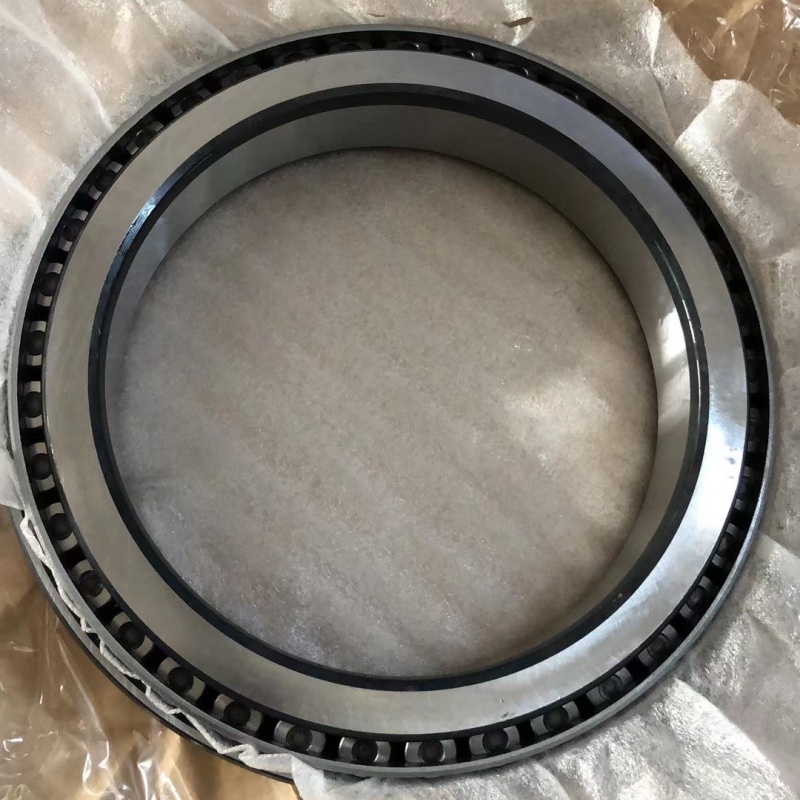
Let me tell you the details of each case.
Case one: Brazil. A stone crusher plant owner named Carlos. His machine uses two large spherical roller bearings. The rocks hit the crusher with shocks of over 10,000 N. His old bearings (a well-known brand) lasted only 15 days. Then the bearing would crack. He called me because he saw our website at fytzbearing.com. I asked him about his load and speed. The speed was low, only 300 RPM. But the load had big spikes. So I recommended our full complement cylindrical roller bearings with a C4 clearance. Full complement means no cage, so we could fit 20% more rollers inside. C4 gives extra room for the shocks. Carlos ordered two sets. After three months, he emailed me: "The bearings are still running. No noise. No heat." He ordered ten more sets. Now he replaces them every six months. That is twelve times longer life than before.
Case two: Egypt. A truck axle manufacturer named Ahmed. He makes axles for heavy trucks that carry sand and cement. His old taper roller bearings from a local trader failed at 20,000 km. The rollers would pit and spall. Ahmed’s warranty cost was killing his profit. He found me through a Google search. I told him that his problem was not the bearing design. It was the steel quality. The local trader used cheap steel with many impurities. At FYTZ, we use vacuum-degassed chromium steel. We also do a heat treatment that gives 62 HRC hardness. Ahmed tried one container of our taper roller bearings. After six months, his failure rate dropped from 8% to 1.5%. That cut his warranty costs by 80%. He now buys all his bearings from us.
Case three: India. A procurement manager named Rajesh (like my typical customer). He supplies bearings to textile mills. His client had a loom with a high-speed shaft that kept seizing. The shaft ran at 8,000 RPM. The old deep groove bearings had a normal clearance (CN). At high speed, the shaft heated up and expanded. Then the clearance closed to zero. The bearing locked up. Rajesh called me. I suggested our P5 grade deep groove bearings with a C3 clearance. The C3 gives extra room for the heat expansion. The P5 precision reduces vibration. Rajesh ordered 200 pieces. His client reported zero seizing for the next nine months. Rajesh now sends me an order every quarter.
Here is a summary table of these cases:
| Customer | Country | Bearing Type | Old Life | New Life | Gain |
|---|---|---|---|---|---|
| Carlos (stone crusher) | Brazil | Cylindrical roller, full complement | 15 days | 6 months | 12x |
| Ahmed (truck axles) | Egypt | Taper roller | 20,000 km | 80,000 km | 4x |
| Rajesh (textile loom) | India | Deep groove, C3 clearance | 2 months (seizing) | 9 months | 4.5x |
So yes, high load capacity bearings save you money. You just need to pick the right type, the right clearance, and the right steel. And that is exactly what I help my customers do every day.
Conclusion
High load capacity comes from the right bearing type, internal design, and material. Match them to your real load and speed, and you will stop breaking bearings.