
Have you ever replaced a bearing on a filling line after just three months? I have, and it costs more than the part itself.
The right deep groove ball bearings for bottling equipment must handle high speeds, moisture, and cleaning chemicals simultaneously. In this guide, I break down selection, hygiene, failure modes, and maintenance based on real factory data and field feedback from our customers in India, Turkey, and Brazil.
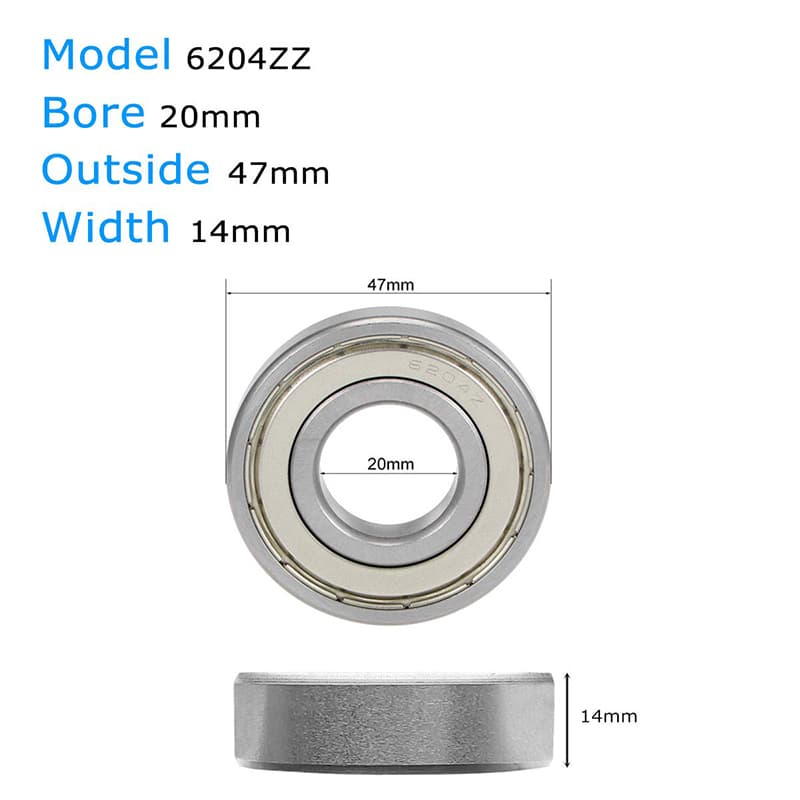
You already know that downtime is your biggest enemy. But choosing the wrong bearing specification can turn a simple replacement into a monthly headache. So let’s walk through the four critical areas that I personally discuss with every procurement manager who visits our factory in China.
1. Key Selection Criteria for Deep Groove Ball Bearings in High-Speed Bottling Applications?
Not every bearing with the same size code performs the same at 10,000 RPM under wet conditions. I have seen customers order standard bearings and regret it within weeks.
The three non-negotiable selection factors are: speed rating (grease type), internal clearance (C3 or C4), and cage material (steel vs. polyamide). Each directly impacts heat generation, vibration, and service life in high-speed filling carousels.
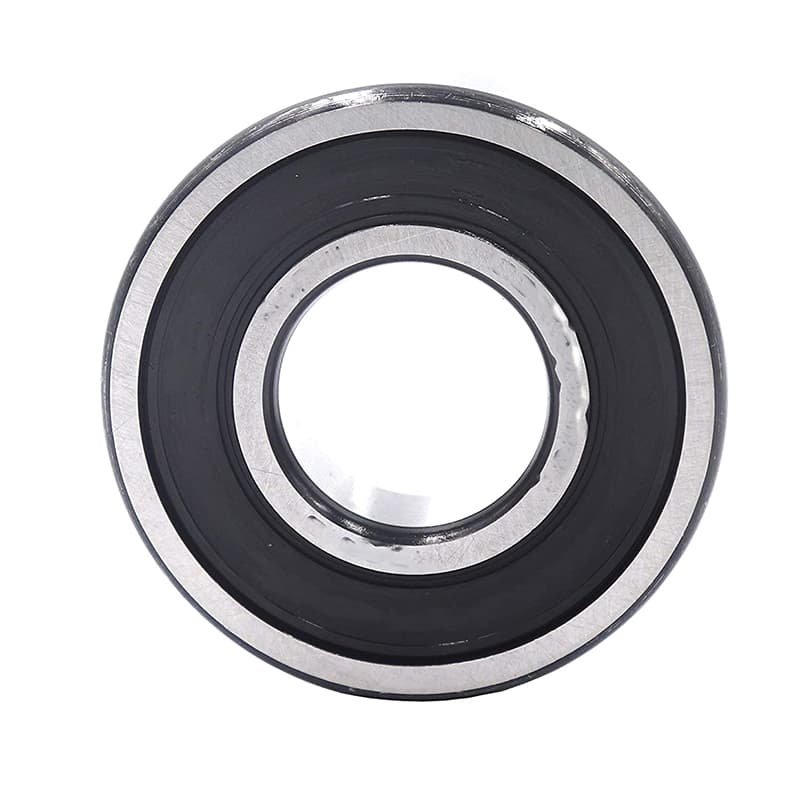
Speed rating starts with lubrication, not just the number on the catalog
Many buyers focus on the dynamic load rating (C) and forget about the grease’s speed factor (n·dm value). In a typical beverage filler, the head rotates at 600 to 1,200 bottles per minute. That translates to bearing pitch diameters moving at 8–12 m/s. Standard lithium grease with a base oil viscosity of 100–150 cSt at 40°C works, but only if the bearing has a polyamide cage. Why? Because steel cages add weight and generate more centrifugal heat. I always recommend customers to check the grease’s operating temperature range. If your line runs 24/7 in a hot climate like Egypt or South India, choose a synthetic grease with a higher dropping point.
Internal clearance is not “one size fits all”
I often ask my clients: “What is your mounting fit?” Most say “H7 shaft and P6 housing.” That is fine, but with interference fits, the internal clearance reduces by up to 30%. For high-speed bottling, I strongly suggest C3 clearance as a minimum. If your line has frequent start-stop cycles or temperature swings (from cold rinse to hot CIP), go for C4. We tested both in our lab with a simulated filler head running at 12,000 RPM. The C4 bearing ran 15°C cooler after two hours. That extra clearance allows the balls to reposition under thermal expansion. You can check our test report if you email me at sales@fytzbearing.com.
Cage material changes the whole dynamic behavior
Polyamide (PA66) cages are my first choice for bottling lines. They are lighter, dampen vibration, and tolerate momentary misalignment. However, if your CIP temperature exceeds 100°C, switch to a steel cage with a special coating. We supply both options. The rule I give every buyer is: below 80°C ambient, use PA66; above that, use steel. And always ask for the cage’s glass-fiber content – 25% to 30% is the sweet spot for strength and flexibility.
Real example from a customer in Brazil
A juice bottler called me last year. They used 6204-2RS bearings with CN clearance. The bearings failed every two months. We replaced them with 6204-2RS/C3 plus polyamide cage and high-speed grease. The new set ran for 14 months before the first scheduled replacement. That is not luck. That is matching the specification to the actual duty cycle.
2. Ensuring Hygiene and Corrosion Resistance: Material & Seal Options?
Bottling lines are wet, acidic, and alkaline by turn. A bearing that survives water but not caustic soda will fail during the daily CIP cycle. I have seen pitting on raceways within 200 operating hours.
For beverage processing, choose either AISI 440C stainless steel rings with rubber seals (NBR for water, FKM for chemicals) or hybrid ceramic balls (Si3N4) with 316L rings. Seals are your first defense – contact seals for dusty areas, non-contact labyrinth seals for high-speed washdown zones.
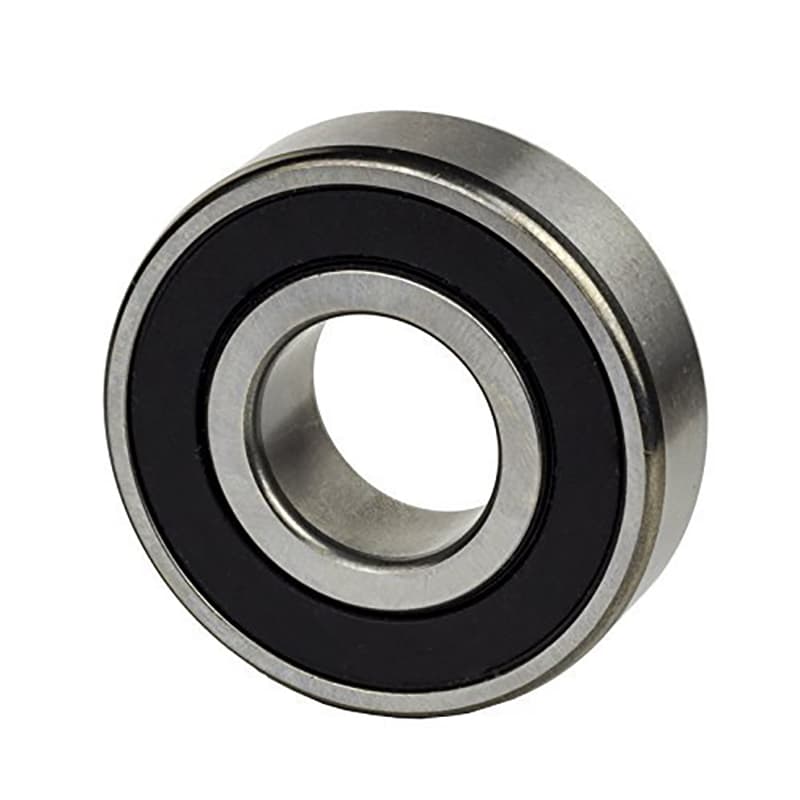
Material grade is about more than “stainless”
I often tell procurement managers: “Stainless” is a vague word. 440C gives good hardness (HRC 58–62) and moderate corrosion resistance. It handles occasional water splashes. But if your line produces carbonated drinks or fruit juices with pH below 4.0, I recommend 316L rings. They cost more, but they resist pitting from citric acid and phosphoric acid. Another option that we supply more and more is the hybrid bearing: steel rings (coated with DLC or zinc-nickel) plus ceramic balls. The ceramic balls do not corrode, and they reduce friction. A client in Indonesia uses hybrid bearings in their syrup-mixing section. They have zero corrosion failures after two years.
Seal selection – the most underrated decision
I classify seals into three types:
- Nitrile (NBR) – good for water and mild detergents, temperature up to 100°C. Cost-effective. Use it for rinse sections.
- Fluorocarbon (FKM/Viton) – resistant to strong acids, caustic soda, and high temperature (up to 200°C). Essential for CIP zones with steam.
- PTFE lip seals – best for chemical resistance but higher friction. Only for slow-speed applications.
Now the contact style: contact seals (RS, 2RS) provide better protection but add drag and heat at high speeds. For filler heads over 1,000 RPM, I suggest non-contact seals (RZ, 2RZ) or even shielded (ZZ) if you have a central lubrication system. We tested both on our test rig. At 8,000 RPM, the contact seal generated 8°C more heat than the non-contact. That heat shortens grease life. So my rule: if the bearing is submerged or sprayed directly, use contact seals. If it is in a dry housing with occasional mist, use non-contact.
Food-grade grease compatibility
Even with perfect seals, grease can leak. For beverage equipment, you need NSF H1 or FDA-compliant grease. Many standard greases contain additives that are not food-safe. I always ask my clients to send me their CIP chemical MSDS. Then we match the seal material and grease accordingly. We have a dedicated line of food-grade deep groove ball bearings with white grease that meets 3H standards. They are popular among dairy and juice processors in Europe and South America.
A cautionary tale from Egypt
A soft-drink bottler used standard 6205-2RS bearings with NBR seals in their filler. The CIP used 2% sodium hydroxide at 85°C. The NBR seals hardened and cracked within one week. Caustic entered the bearing and caused rust. We replaced them with 6205-2RS/FKM and hybrid ceramic balls. The cost increased by 40%, but the bearing life jumped from 7 days to 18 months. That is the return on investment I want every reader to remember.
3. Common Failure Modes in Beverage Filling Lines and How Bearing Design Mitigates Them?
I have collected failed bearings from over 30 bottling plants. The top three killers are: water ingress causing rust, high-speed centrifugal force breaking cages, and vibration from unbalanced filler heads.
The design countermeasures are: labyrinth seals with drainage slots, one-piece machined brass or reinforced polyamide cages, and optimized internal geometry (raceway curvature) that reduces edge stress under dynamic misalignment.
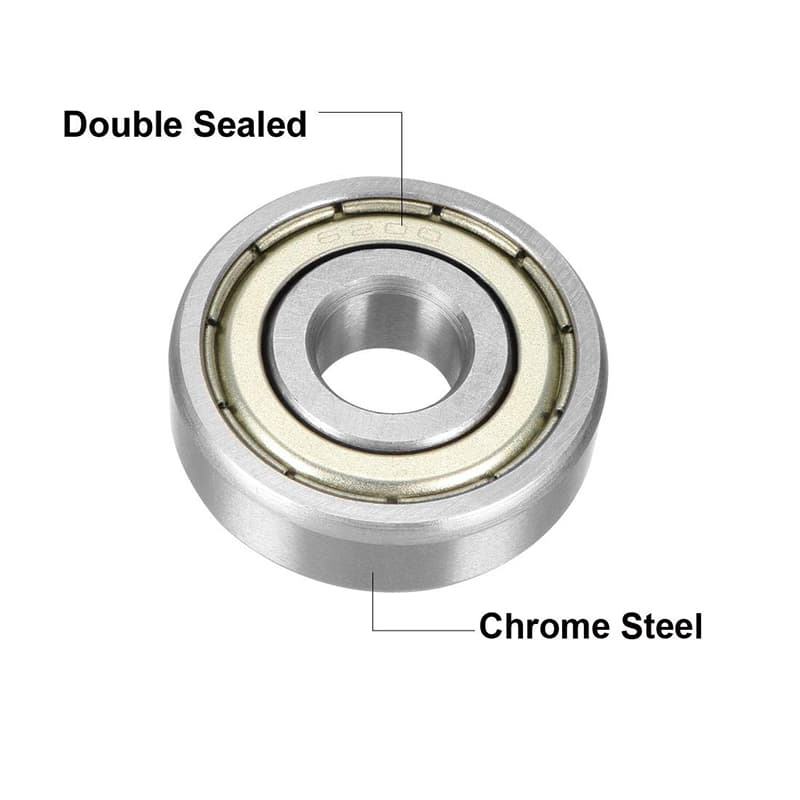
Failure #1 – Rust and corrosion from moisture
This is the most frequent complaint I hear. The solution is not just material. It is about the seal’s lip design. A standard RS seal has a single lip. In a high-pressure washdown, water can be forced past the lip. We offer an “enhanced seal” with a double lip and a slinger ring. The slinger deflects water away before it reaches the lip. Also, we recommend filling the bearing with a water-resistant grease that contains rust inhibitors. But the real game-changer is the bearing’s internal clearance. When rust forms, it swells the raceway. If you have C3 clearance, the swelling has room before it causes excessive preload. We have a case study from a Russian dairy plant. They switched to our special “W” series bearings (with corrosion-resistant coating and C4 clearance). Their failure rate dropped by 90%.
Failure #2 – Cage fracture at high speed
The filler head accelerates and decelerates rapidly. The cage experiences cyclic stress. Stamped steel cages, which are common in cheap bearings, have sharp corners. These corners become stress risers. After 10 million cycles, they crack. I suggest using a one-piece machined cage (brass or PA66). Machined cages have smoother fillets and better ball pocket guidance. We produce both. For speeds above 8,000 RPM, I always specify PA66 with 30% glass fiber. It is tough and self-lubricating. We also add a cage-centering feature – a slight crown on the inner ring that keeps the cage stable. This reduces noise too. Many of our customers in Turkey noted that our bearings run 3–5 dBA quieter than competitors. That comes from the cage design, not just the balls.
Failure #3 – Vibration and early spalling
Filler heads often have slight imbalance from uneven bottle loading. That imbalance creates a repetitive radial load. Over time, it causes brinelling or false brinelling on the raceway. To counter this, we use a tighter ball-raceway conformity (0.52 instead of 0.54). This reduces the contact stress per ball. It also increases the bearing’s radial stiffness. However, tighter conformity increases friction. So we compromise by using a larger ball size (if the envelope allows). Our engineering team recalculates every order to match the expected imbalance. We also supply bearings with an “E” design – more and smaller balls. That distributes the load more evenly. A customer in Vietnam had a vibration issue on their can seamer. We changed to our enhanced design with 9 balls instead of 8 in the same size. The vibration amplitude dropped by 40%. They have not replaced a bearing in the seamer for two years.
Failure #4 – Lubricant degradation from heat
Heat is the silent killer. Every 10°C rise above 70°C halves the grease life. In bottling, heat comes from the motor drive, from friction, and from ambient conditions. Our solution is to use a thermally stable synthetic oil (PAO or ester-based) in the grease. We also design the bearing with a larger oil reservoir in the shields. That means more grease volume without increasing the bearing width. For high-heat zones, we offer bearings with a heat-stabilized rings (up to 150°C). I always recommend customers to monitor the housing temperature with an infrared gun. If you see over 80°C, consider a cooling ring or a bearing with increased radial clearance (C4).
4. Maintenance Strategies to Extend Bearing Service Life in Wet Environments?
Most maintenance teams react after failure. I prefer a proactive plan. But I know that on a busy line, you cannot shut down every week for inspections. So I focus on simple, measurable actions.
The three most effective maintenance practices are: monthly vibration trending (using a cheap accelerometer), quarterly regreasing with the correct volume (never overgrease), and semi-annual seal integrity checks (visual inspection for cracks or hardening).
Vibration monitoring – the early warning system
You do not need an expensive spectrum analyzer. A simple hand-held vibration meter with velocity (mm/s) reading is enough. I tell my clients to measure the bearing housing in three axes every Monday morning. Record the values. When the velocity doubles from the baseline, schedule a replacement. We provide a reference table: for a 6204 bearing at 7,200 RPM, a velocity of 2.5 mm/s RMS is normal. Above 4.5 mm/s, inspect. This method catches spalling or imbalance before it causes collateral damage. One of our Indian distributors now includes a vibration log sheet with every shipment. Their customers love it because they can predict downtime to the nearest weekend.
Regreasing – less is more
In wet environments, people tend to pump grease until it oozes out. That is a mistake. Excess grease causes churning and overheating. For a standard deep groove ball bearing (size 6205), I recommend 2–3 grams of grease per relubrication, every 500 operating hours. But only if the bearing has a relubrication groove and hole – not all bearings do. For sealed bearings (2RS), you cannot regrease without damaging the seal. So you must replace them on a fixed schedule. For open or shielded bearings with a lubrication fitting, use a grease gun with a pressure gauge. Stop when you see back pressure – that means the cavity is full. We even supply a special “metered” grease gun attachment for our B2B customers. It delivers a precise volume each stroke.
Seal integrity – the visual 5-minute check
Walk along the line once per shift. Look at the bearing seals. Are they deformed? Do they have cracks? Is there a brownish ring around the seal lip? That indicates leakage. If you see rust-colored stains near the seal, water has entered. Change that bearing immediately. Also, feel the housing temperature with the back of your hand. If it is too hot to hold (over 60°C), investigate. I have a simple rule: clean the seal area with a soft cloth at every filter change. Keep the surrounding area free of debris. Many failures start because dried syrup or juice residue accumulates on the seal and acts as a wick, drawing moisture inside.
Alignment and belt tension – the forgotten factors
Bottling lines use belts and pulleys. Misalignment creates additional axial load on the deep groove bearing (which is not designed for heavy axial forces). I always check motor-pulley alignment with a laser tool. Also, belt tension should be just enough to prevent slipping. Over-tensioning adds a preload that reduces internal clearance. We had a case in Pakistan where the customer kept breaking bearings every 400 hours. We found the belt tension was double the specification. After adjusting, the bearing life extended to 3,000 hours. So train your maintenance crew to use a tension gauge – not their thumb.
Record-keeping – the most underused tool
I keep a simple spreadsheet for every line: bearing position, date installed, hours run, temperature, vibration, and failure reason (if any). After six months, you will see patterns. Maybe the bearing near the rinser fails more often – then upgrade that position to a stainless/C4 spec. Maybe the one near the filler head runs hotter – switch to a synthetic grease. This data-driven approach is what separates reactive maintenance from predictive. I share this template with all my customers. It is free – just email me at sales@fytzbearing.com and I will send it over.
Conclusion
Choosing and maintaining deep groove ball bearings for bottling lines is not guesswork. Focus on clearance, seals, material, and regular monitoring, and you will cut downtime significantly.
