
A single corroded bearing can shut down your entire production line and risk product contamination. The wrong material choice has real consequences.
Stainless steel pillow block bearings are essential for food and beverage processing because they resist corrosion from water, steam, cleaning chemicals, and acidic foods. Their smooth, non-porous surface prevents bacterial growth and meets strict hygiene standards like FDA, USDA, and 3-A, ensuring product safety and equipment longevity.

In food and beverage plants, bearings face a unique set of enemies: daily high-pressure washdowns, acidic fruit juices, sugary syrups, and strict sanitation protocols. Standard carbon steel bearings rust quickly in this environment. That rust contaminates products and creates maintenance nightmares. Stainless steel pillow blocks solve this problem. They are more than just a bearing; they are a critical component of your food safety system. Let’s explore how to select, use, and maintain them properly.
How to determine pillow block bearing size1?
Choosing the wrong size leads to immediate failure, excessive downtime, and wasted money. You need a systematic approach, not a guess.
You determine pillow block bearing size1 by identifying the shaft diameter2, then calculating the load and speed requirements. The shaft diameter2 sets the bearing bore size3. The load and speed determine the bearing type (ball, spherical) and series within that bore size to ensure adequate life.

Sizing is a two-step process: fitting the shaft and surviving the job. It combines measurement with calculation.
A Step-by-Step Guide to Precise Sizing
Follow these steps to ensure you get the correct bearing unit every time. This process applies whether you are replacing a failed unit or designing a new machine.
Step 1: The Non-Negotiable First Measurement – Shaft Diameter
This is the starting point. The bearing bore must match the shaft perfectly.
- Tool: Use a precision caliper or micrometer. Do not use a ruler.
- Measure: Measure the shaft where the bearing will sit. Measure in several places and at right angles to check for wear or ovality.
- Result: You get a measurement in millimeters or inches (e.g., 25mm, 1.18 inches). This number directly corresponds to the bearing’s "bore" size. For a 25mm shaft, you need a bearing with a 25mm bore.
Step 2: Understanding the Pillow Block Code4
Pillow blocks have standard designation codes. For example, a common code is UCP 205.
- "UCP": This indicates the housing style (a two-bolt pillow block with a setscrew lock).
- "205": This is the bearing number. The last two digits ("05") multiplied by 5 give you the bore diameter in millimeters. 05 x 5 = 25mm bore.
Step 3: Selecting the Bearing Type Inside the Housing
Once you know the bore, you must choose the right bearing insert for the job. The housing (the "pillow block") is just a holder. The bearing inside does the work.
- For Light to Moderate Loads, High Speed: Deep Groove Ball Bearing5 inserts (like the one in a UCP 205). These are common, cost-effective, and handle some axial load.
- For Heavy Radial Loads and Misalignment: Spherical Roller Bearing6 inserts (found in heavier series like SAP 205). These are for conveyors, agitators, and other tough applications.
- For Food & Beverage: You then specify the material. You would order a UCP 205 in stainless steel or with a stainless steel housing and a sealed, food-grade lubricated bearing7.
Step 4: Calculating for Load and Life (The Engineering Step)
For critical or new applications, you must check that the bearing can handle the load for a required life (L10 life). You need:
- Radial Load (Fr): How much weight or force is pushing down/ sideways on the bearing?
- Axial Load (Fa): Is there any push/pull force along the shaft?
- Speed (n): How fast will the shaft rotate (RPM)?
With these, you or your supplier can use the bearing’s Basic Dynamic Load Rating8 (C) from the catalog to calculate the theoretical service life. For a replacement, if the old bearing lasted an acceptable time, simply matching its type and series is usually sufficient.
A Practical Table for Quick Reference
| Scenario | Key Size Determinant | Recommended Bearing Insert Type |
|---|---|---|
| Replacing a failed unit | Measure old shaft. Match existing housing code (e.g., UCP 205). | Use the same type. If it failed early, consider upgrading (e.g., from ball to spherical roller). |
| New conveyor roller (moderate load) | Shaft diameter (e.g., 20mm). | Deep groove ball bearing insert (UCP 204). Stainless steel housing. |
| New heavy-duty mixer shaft | Shaft diameter & High radial load calculation. | Spherical roller bearing insert (SAP series). Stainless steel housing. |
| High-speed bottling line | Shaft diameter & High speed requirement. | Deep groove ball bearing with food-grade seals. Precision grade may be needed. |
Advice for Distributors like Rajesh
When a bakery customer in Mumbai calls Rajesh with a rusty bearing on a dough sheeter, Rajesh needs to ask: "What is the shaft size?" and "Is it washed down daily?" Based on the shaft size (say, 30mm), he can identify the code (UCP 206). Knowing it’s for food, he should recommend the stainless steel version. He should also ask if the old bearing failed from load or just corrosion. This simple process turns a confused customer into a confident buyer and ensures the right part is delivered.
What are the common problems with pillow blocks?
Even the best stainless steel pillow block will fail if underlying problems are not addressed. Knowing these issues helps you prevent them.
Common problems with pillow block bearings include contamination ingress leading to wear, lubrication failure (washout or grease degradation), corrosion (if not stainless in wet environments), misalignment causing uneven load and heat, and loose fits creating vibration and fretting corrosion.

Problems usually stem from a few root causes. Identifying the symptom tells you what went wrong and how to fix it for good.
Diagnosing and Solving Frequent Failure Modes
Let’s look at each common problem, its cause, its symptom, and the corrective action.
1. Contamination: The Silent Killer
This is the top problem in food processing. Water, cleaning chemicals, food particles, and microbes get inside the bearing.
- Cause: Failed or inadequate seals. Standard lip seals may not withstand daily high-pressure washdowns.
- Symptom: Grinding noise, rough rotation, grease washed out (visible grease leakage or grease turned milky from water mixing).
- Solution: Use pillow blocks with multiple labyrinth seals or PTFE (Teflon) seals designed for washdown. Ensure grease fittings have sealed caps. Implement a relubrication schedule after cleaning to purge any moisture that entered.
2. Lubrication Failure
Bearings need the right grease in the right amount. In food plants, grease can be washed away or degrade from heat and chemicals.
- Cause: Using standard industrial grease that is not water-resistant or food-grade. Infrequent re-lubrication.
- Symptom: Squeaking or screeching noise, high operating temperature, sudden seizure.
- Solution: Use only NSF H1 registered food-grade lubricants. These are safe for incidental food contact. Choose greases with high water resistance and anti-washout properties. Relubricate at intervals recommended for the harsh environment (often more frequently than standard charts suggest).
3. Corrosion
Even with stainless steel housings, corrosion can occur on fasteners (bolts) or on the shaft itself if it is not stainless.
- Cause: Using carbon steel set screws or mounting bolts with a stainless housing. A carbon steel shaft with a stainless bearing.
- Symptom: Rust stains, seized set screws, pitting on the shaft under the bearing.
- Solution: Specify complete stainless steel units, including fasteners. If the shaft is carbon steel, ensure the bearing’s inner ring is properly sealed and consider using a stainless steel sleeve on the shaft at the bearing location.
4. Misalignment
When two pillow blocks supporting a shaft are not perfectly in line, they fight each other.
- Cause: Improper installation, frame flexing, thermal expansion.
- Symptom: One bearing wears out much faster than the other. The bearing runs hot. Uneven wear pattern on the seal.
- Solution: Laser align the pillow blocks during installation. For longer spans, use self-aligning bearing inserts (spherical roller bearings or ball bearings with a spherical outer ring) that can compensate for small alignment errors.
5. Loose Fits and Vibration
The bearing must be tight on the shaft and in the housing. If it is loose, it will micro-move.
- Cause: Worn shaft, incorrect tolerances, loose set screw.
- Symptom: Vibration, fretting corrosion (red dust at the fit), noticeable play if you try to move the shaft up and down.
- Solution: Ensure the shaft is the correct tolerance (usually g6 or h6). Use a proper locking method (eccentric locking collar, setscrew on a ground flat on the shaft). Check and tighten fasteners during routine maintenance.
A Troubleshooting Guide for Maintenance Teams
| Problem Observed | Likely Root Cause | Immediate Action | Long-Term Fix |
|---|---|---|---|
| Rust on housing | Wrong material (carbon steel). | Clean and apply corrosion inhibitor (temporary). | Replace with stainless steel pillow block. |
| Grease leaking, milky grease | Seal failure, water ingress. | Relubricate to purge water. | Install pillow blocks with enhanced washdown seals. |
| Bearing noisy and hot | Lubrication failure or misalignment. | Stop machine. Check for grease. | Relubricate with food-grade grease. Laser align shaft. |
| Shaft has play inside bearing | Loose fit, worn shaft. | Tighten locking device. | Repair or replace shaft. Ensure correct tolerance. |
What is the purpose of a pillow block bearing?
It’s easy to see it as just a block of metal holding a bearing. But its purpose is more strategic and solves fundamental mechanical problems.
The purpose of a pillow block bearing is to provide a ready-to-mount, self-contained support unit for a rotating shaft. It simplifies installation, protects the bearing from the environment with its housing and seals, and allows for easy maintenance and replacement without redesigning the machine.
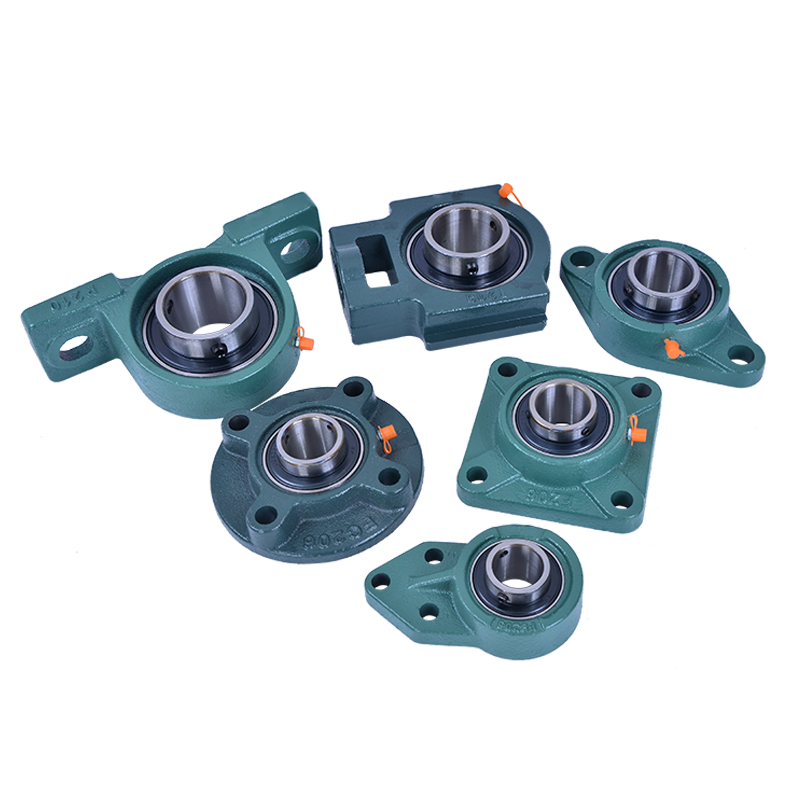
A pillow block is a brilliant piece of design standardization. It takes a complex mechanical requirement and turns it into a simple, off-the-shelf component.
The Multifunctional Role of a Pillow Block
Let’s break down its purposes into clear, practical benefits for machine builders and maintainers.
1. Simplification of Machine Design and Assembly
Without pillow blocks, supporting a shaft is complex. You need to:
- Machine a precise housing in the machine frame.
- Press a bearing into that housing.
- Add separate seals.
- Design a method to lock the bearing axially.
A pillow block does all this in one pre-assembled unit. The designer just specifies the code (e.g., UCP 205) and bolts it onto a flat surface. This saves enormous design time, machining cost, and assembly labor.
2. Environmental Protection and Sealing
The housing acts as a shield. It protects the bearing from direct exposure to dust, dirt, splashing liquids, and physical impacts. Integrated seals (rubber, labyrinth) provide the first line of defense against contamination. In food-grade stainless units, the smooth housing also prevents dirt traps and makes cleaning easier.
3. Accommodation of Misalignment (Some Types)
Many pillow blocks are designed with self-aligning bearing inserts. The bearing inside has a spherical outer surface that can rotate slightly within the housing’s spherical seat. This allows the bearing to align itself with the shaft, compensating for small errors in mounting or frame deflection. This is a critical feature for long shafts or less rigid frames.
4. Facilitation of Maintenance and Replacement
This is a huge advantage. When a bearing fails:
- You unbolt the entire pillow block from the frame.
- You unbolt the shaft coupling (if any).
- You slide the old unit off the shaft.
- You slide a new, pre-lubricated, pre-sealed unit on.
- You bolt it back in place.
The machine is back running quickly. You don’t need to press bearings in and out on the shop floor, which risks damage. This modularity minimizes downtime.
5. Load Support and Shaft Positioning
At its core, the pillow block must:
- Support Radial Loads: Carry the weight of the shaft and any components (gears, pulleys, rollers) attached to it.
- Restrict Axial Movement: Keep the shaft from sliding side-to-side. This is done through the bearing’s internal design or by using two pillow blocks as a "fixed" and "float" arrangement.
- Provide Stable Rotation: Maintain precise shaft location to ensure gears mesh correctly and belts run true.
Types of Pillow Blocks and Their Specific Purposes
| Pillow Block Type | Key Feature | Primary Purpose / Best For |
|---|---|---|
| 2-Bolt (UCP) | Compact, common. | General purpose, light to medium duty. Conveyors, fans. |
| 4-Bolt (SAF) | More stable mounting. | Heavier loads, higher forces. Agitators, heavy conveyors. |
| Flanged | Mounts on vertical surface. | Supporting shaft ends where a base is not available. |
| Take-Up Units | Adjustable position. | Belt or chain tensioning applications. |
| Stainless Steel | Corrosion-resistant material. | Food, beverage, pharmaceutical, chemical, and marine washdown environments. |
For a business like Rajesh’s, understanding these purposes is marketing gold. He’s not just selling a "UCP 205." He’s selling "a pre-sealed, easy-to-install shaft support that will cut your assembly time and simplify future maintenance." For his food processing customers, he’s selling "a corrosion-proof, hygienic bearing unit that meets safety standards and keeps your line running." This frames the product as a solution, not just a part.
How do you align a pillow block bearing?
Poor alignment is a leading cause of premature failure, even with self-aligning bearings. Proper alignment is a skill that saves money.
You align pillow block bearings by first ensuring their bases are level and coplanar, then using precision tools like a laser alignment system or straightedge and feeler gauges to adjust their positions so their bores are perfectly coaxial. The goal is to have the shaft rotate freely without binding or inducing side loads.

Alignment is not about eyeballing it. It is a measured, step-by-step process. Even a small error multiplies over distance and causes stress.
A Detailed Procedure for Precise Alignment
Follow this sequence to ensure your pillow blocks work together, not against each other.
Pre-Alignment Preparation
- Clean Surfaces: Ensure the machine frame mounting surfaces are clean, flat, and free of burrs.
- Loose Mounting: Place the pillow blocks on the frame and insert the bolts, but only tighten them finger-tight. The blocks must be able to slide for adjustment.
- Install Shaft (Optional): For some methods, you place the shaft through both bearings. For laser alignment, you often use alignment rods that mimic the shaft.
Alignment Method 1: The Straightedge and Feeler Gauge Method (For Shorter Spans)
This is a traditional, low-tech but effective method for shafts under about 1.5 meters.
- Step A – Height Alignment (Vertical): Place a precision straightedge across the top of both pillow block housings. Use a feeler gauge to check the gap between the straightedge and each housing. Adjust the shims under the pillow block feet until the gap is zero at both ends. This ensures they are at the same height.
- Step B – Side-to-Side Alignment (Horizontal): Rotate the straightedge to the side of the housings. Repeat the feeler gauge process to align them horizontally.
- Step C – Angular Alignment (Twist): This checks if one bearing is twisted relative to the other. Place the straightedge against the side of one housing and extend it towards the other. The straightedge should make full, even contact along the side of the second housing. If not, adjust by twisting the block.
Alignment Method 2: Laser Alignment (The Gold Standard for Any Span)
This is the most accurate method, especially for long shafts or critical machinery. Modern laser tools are easy to use.
- A laser emitter unit is attached to one pillow block (or a dummy shaft).
- A detector unit is attached to the other pillow block.
- The laser beam plots the centerline. The detector shows exactly how much the second block is out of alignment—in height, horizontally, and at an angle—with live digital readouts.
- You adjust the second block until the readouts are within tolerance (often specified in mils or microns).
- This method is fast, very precise, and removes all guesswork.
Alignment Method 3: Using a Dial Indicator
A dial indicator mounted on the shaft can measure runout as you rotate it, helping to identify misalignment. This is more common for aligning couplings between two separate shafts, but can be used to fine-tune pillow block alignment.
Critical Considerations for Food & Beverage Applications
- Thermal Growth: In processing lines with hot products (cooking, pasteurization), the shaft and frame will expand when heated. You may need to align the machine at its operating temperature or calculate and set a "cold alignment offset" to ensure it becomes aligned when hot.
- Soft Foot: This occurs when one foot of a pillow block isn’t sitting flat on the frame due to dirt or a warp. When you tighten the bolts, it distorts the block and misaligns the bearing. Always check for soft foot by tightening each bolt sequentially and watching the alignment readings. Shim as needed to make all feet solid.
- The "Fixed" and "Float" Concept: On long shafts, thermal expansion can cause the shaft to grow in length. To accommodate this, one pillow block is typically designated as the "fixed" bearing (it locates the shaft axially). The other is the "float" bearing (it allows the shaft to slide through it axially). Misaligning the float bearing can cause it to bind and wear quickly.
Post-Alignment Steps
- Final Tightening: Once perfectly aligned, tighten the mounting bolts in a cross-pattern to the specified torque. Re-check alignment after tightening, as bolts can pull the block slightly out of position.
- Lock Set Screws/Eccentric Collars: Finally, secure the bearing to the shaft using the locking device (setscrew on a ground flat, or by tightening the eccentric locking collar).
- Verify Free Rotation: The shaft should spin freely by hand with no binding or tight spots.
For Rajesh’s customers running packaging or bottling lines, a misaligned conveyor shaft causes bearings to fail every few months, creating constant downtime. Rajesh can provide more value by sharing these alignment basics or even recommending a local service technician. Helping a customer solve their root problem (misalignment) ensures the stainless steel bearings he sells will last their full design life, proving their value and cementing his reputation as a reliable supplier.
Conclusion
In food and beverage processing, stainless steel pillow block bearings are not just components; they are investments in hygiene, reliability, and compliance. Correct sizing, understanding their purpose, preventing common failures, and ensuring precise alignment are all essential to maximizing their value and keeping your production line running smoothly.
-
Understanding how to determine the right pillow block bearing size is crucial for ensuring optimal performance and longevity. ↩ ↩
-
Accurate measurement of shaft diameter is essential for selecting the correct bearing, preventing failures and downtime. ↩ ↩
-
Knowing the factors that influence bearing bore size helps in making informed decisions for machinery design and maintenance. ↩
-
Understanding the Pillow Block Code is vital for selecting the right bearing type and ensuring compatibility with your application. ↩
-
Exploring the benefits of Deep Groove Ball Bearings can help you choose the best option for light to moderate load applications. ↩
-
Learning when to use Spherical Roller Bearings can enhance performance in heavy-duty applications and improve reliability. ↩
-
Discovering the advantages of food-grade lubricated bearings is crucial for applications in the food and beverage industry. ↩
-
Understanding how to calculate Basic Dynamic Load Rating is essential for ensuring the bearing can handle the expected loads. ↩