
In a mining operation, a failed bearing can halt a crusher, a conveyor, or a shovel. Downtime costs thousands per minute. You need bearings that can survive dust, shock, and vibration. Deep groove ball bearings are everywhere, but using them correctly in this harsh world requires specific knowledge.
For mining and quarry equipment, select deep groove ball bearings with robust cages (steel or brass), maximum sealing (contact seals like 2RS), appropriate internal clearance (C3 for heat), and ensure they are properly sized for the actual loads. Avoid using them for pure high-shock radial loads where roller bearings are superior.
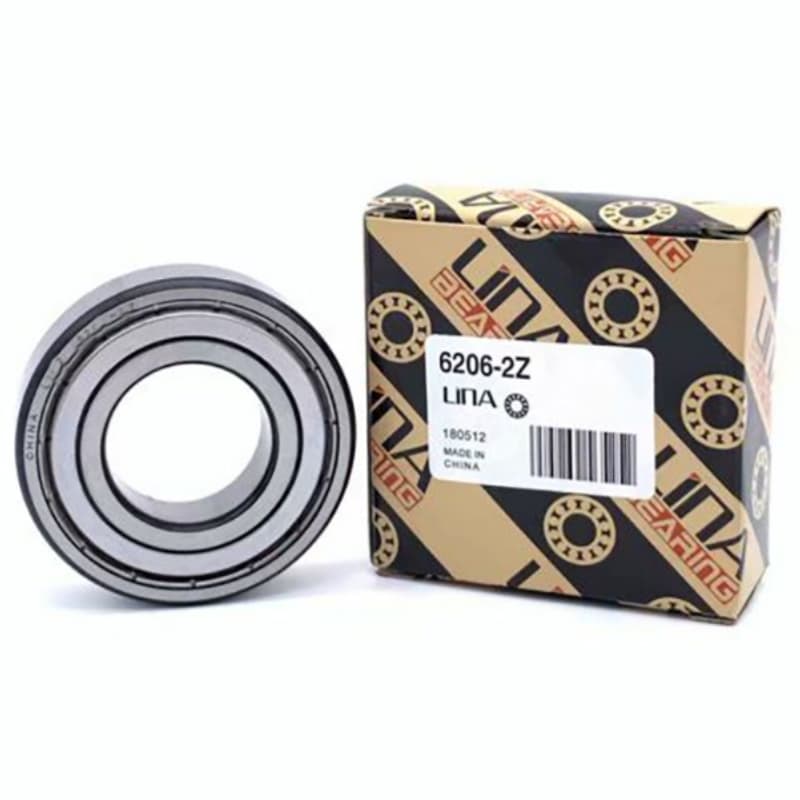
Success in this brutal environment starts with understanding the tool. We need to define what a deep groove bearing is, honestly assess its weaknesses, distinguish it from similar types, and know its core components to make smart, durable selections for crushers, screens, and conveyors.
What is a deep groove ball bearing1?
This is the most fundamental bearing type, but its name holds the key to its capability. In mining, you don’t just need "a bearing"; you need to know if this design is right for the job. Its definition explains where it can and cannot succeed.
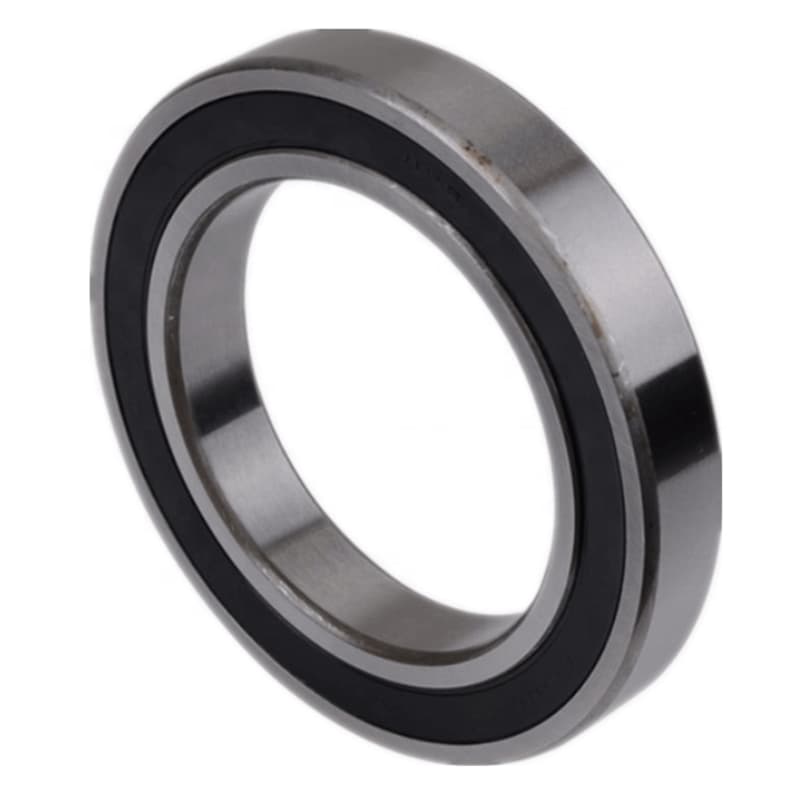
A deep groove ball bearing1 is a type of rolling-element bearing with continuous, deep raceways (grooves) on both the inner and outer rings. This design allows it to support significant radial loads2 and moderate axial (thrust) loads from both directions, making it versatile for a wide range of applications, including many in general industrial machinery.
The Anatomy of Versatility and Its Mining Implications
Let’s break down this definition and relate it directly to the conditions in a mine or quarry.
1. The "Deep Groove" – The Load Path
The raceways are not shallow ditches; they are deep, arcing channels. This deep geometry is crucial.
- Radial Load Support: The deep groove cradles the balls, allowing them to effectively support loads pressing perpendicular to the shaft (radial loads2). This is the weight of a conveyor roller or the belt tension.
- Axial Load Capability: Because the groove is deep and continuous, the balls can also transmit force along the shaft axis (axial loads3) to a certain degree. This is useful for applications with slight thrust, like some fan impellers or misaligned shafts.
2. The "Ball" Element – Friction and Speed
The use of balls (point/elliptical contact) vs. rollers (line contact) defines its performance profile.
- Advantage (for mining): Balls generate lower friction4 than rollers. This means they can run at higher speeds with less heat generation. This is good for motor bearings, fan shafts, and faster-running auxiliary equipment in a plant.
- Disadvantage (for mining): Point contact means lower load capacity for a given size compared to a roller bearing. A ball bearing will deform more under a heavy crushing load.
3. The "Bearing" – A Complete System
It’s not just rings and balls. It includes a cage to separate the balls and often shields or seals. For mining, the choice of cage and seal5 is often more important than the base bearing design.
Mining Application Context:
In a quarry, you’ll find deep groove ball bearing1s in:
- Electric Motors (crusher motors, conveyor drive motors).
- Gearboxes (supporting shafts with combined loads).
- Fans and Pumps (cooling fans, water pumps).
- Smaller Conveyor Rollers (with light to moderate loads).
You will not typically find them as the primary bearing in:
- Crusher Main Shafts (extremely high shock and radial load – uses spherical or tapered rollers).
- Vibrating Screen Bearings (high vibration and misalignment – uses spherical rollers with C4 clearance).
- Heavy-Duty Wheel Hubs (very high radial load – uses tapered rollers).
Understanding this definition helps you place it correctly in the equipment ecosystem. It is a workhorse for driven components, not necessarily for the primary load-bearing points of the most brutal machines.
What are the disadvantages of deep groove ball bearings?
No bearing is perfect. In the punishing world of mining, the disadvantages of deep groove ball bearings are magnified. Ignoring these limitations when selecting them for quarry equipment is a direct path to premature, costly failure.
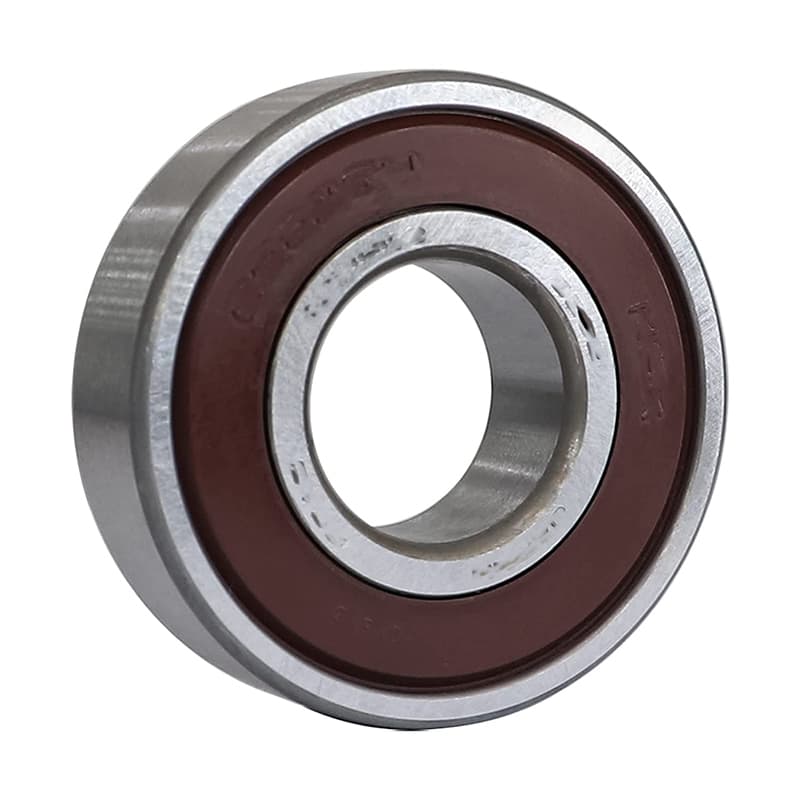
Key disadvantages include limited axial load capacity, sensitivity to misalignment, lower radial stiffness (rigidity) compared to roller bearings, and in standard grades, higher noise and vibration. In mining, these translate to risks of overload, rapid wear from shaft deflection, and failure in high-shock or misaligned conditions.
Why These Weaknesses Matter in a Quarry
Let’s examine each disadvantage through the lens of dust, shock, and heavy loads.
1. Limited Axial Load Capacity1: The Thrust Problem
While they handle some axial load, they are not thrust bearings.
- Mining Scenario: A conveyor head pulley shaft might experience axial thrust from belt tracking issues or uneven loading. A deep groove bearing there could be overloaded axially, leading to brinelling2 (indentations) on the raceways and rapid failure.
- Practical Tip: If axial loads are significant, use a dedicated thrust bearing or a bearing pair designed for thrust (like angular contact ball bearings). For deep groove bearings, always check the axial load rating (C0a) in the catalog and apply a large safety factor.
2. Misalignment Sensitivity3: The Bending Problem
They are designed for very little internal misalignment (typically < 0.1°).
- Mining Reality: Foundations shift. Shafts bend under load. Housings get knocked. Any misalignment forces the balls to run on the edges of the raceways instead of the center. This causes stress concentration, heat, noise, and drastically reduced life.
- Practical Tip: In mining applications, assume misalignment will occur. For deep groove bearings, this demands extremely precise installation and alignment. Use laser alignment tools. For applications where misalignment is unavoidable (like long conveyor shafts), consider self-aligning ball bearings4 or spherical roller bearings instead.
3. Lower Radial Rigidity5: The Deflection Problem
Under the same radial load, a ball bearing will deflect (elastic deformation) more than a cylindrical roller bearing6.
- Mining Impact: In a gearbox supporting a crusher drive, excessive shaft deflection can misalign gears, causing noise, wear, and failure. The bearing’s lack of stiffness becomes a system weakness.
- Practical Tip: For applications requiring high rigidity (like precision gear meshes or locations where shaft position is critical), select a larger bearing size (which increases rigidity) or consider a cylindrical roller bearing6 for pure radial loads.
4. Noise, Vibration, and Shock Sensitivity7
Standard deep groove bearings are not optimized for quiet operation. More importantly, the point contact of balls is less forgiving of shock loads than the line contact of rollers.
- Mining Impact: The constant impact from rocks in a crusher feed or the start-up shock of a large conveyor can cause brinelling2 (static indentation) in ball bearings.
- Practical Tip: For locations with heavy shock, choose bearings with tough, ductile steel and robust cages. Consider using spherical roller bearings which are inherently better at absorbing shock. For deep groove bearings, ensure the static load rating (C0)8 is much higher than the actual shock load.
| Disadvantage | General Consequence | Consequence in Mining/Quarry | Selection/Mitigation Tip |
|---|---|---|---|
| Low Axial Capacity | Risk of raceway indentation under thrust. | Failure on pulleys or fans with axial drift. | Verify axial load rating; use thrust bearings if needed. |
| Misalignment Sensitivity3 | Edge loading, heat, reduced life. | Rapid failure due to foundation shift or impact. | Precision installation is non-negotiable. Consider self-aligning types. |
| Low Radial Rigidity | Greater shaft deflection under load. | Gear misalignment in drives, reduced accuracy. | Upsize bearing; use roller bearings for high rigidity needs. |
| Shock Sensitivity | Brinelling from impact loads. | Premature failure in crushers, feeders, shakers. | Check static load rating (C0)8; use robust design; prefer roller bearings for high shock. |
Acknowledging these disadvantages is not to avoid deep groove ball bearings in mining, but to use them wisely. Put them where their strengths (speed, low friction) are needed and their weaknesses are not challenged.
What is the difference between deep groove and shallow groove ball bearings?
This is a subtle but important distinction, especially for load capacity. The term "shallow groove" isn’t standard, but it often refers to bearings designed primarily for thrust, or it’s a misstatement. Understanding the real comparison prevents selecting the wrong bearing for a radial load.
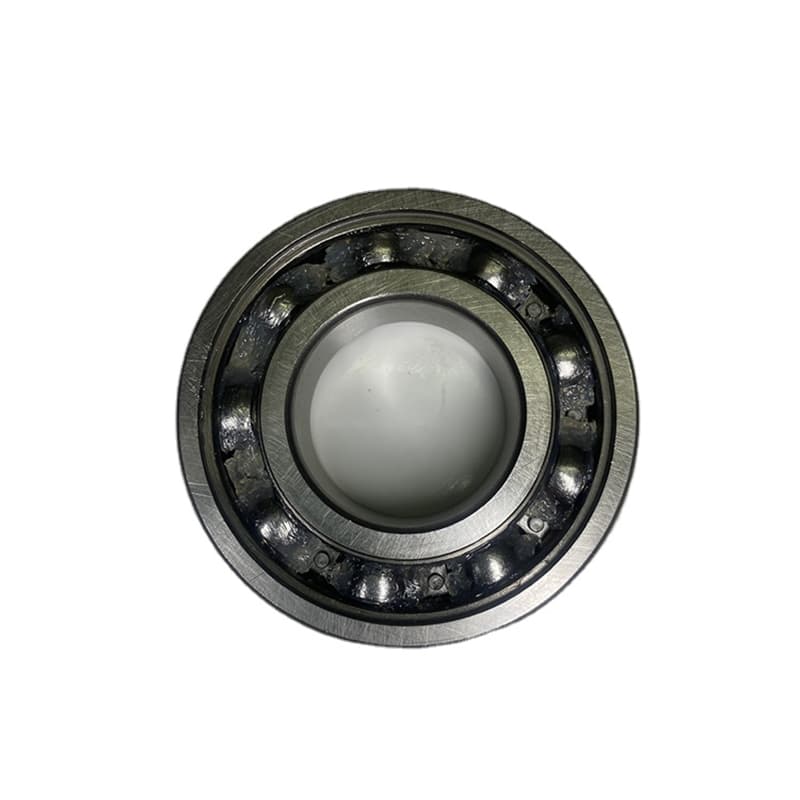
The primary difference is the depth and shape of the raceways. Deep groove ball bearings have deep, continuous raceways that can handle combined radial and axial loads. "Shallow groove" typically refers to angular contact ball bearings or thrust ball bearings, which have shallower raceways optimized for high axial loads in one direction, with limited radial capacity.
Raceway Geometry: The Key to Load Direction
In mining equipment, you often have specific load directions. Picking the wrong geometry means the bearing won’t perform as intended.
Deep Groove Ball Bearings1: The Generalist
- Raceway: Deep, continuous, and approximately semicircular. The curvature radius is slightly larger than the ball radius.
- Load Capacity2: Good radial capacity. Moderate axial capacity in both directions. The deep groove allows the balls to transmit force at an angle.
- Typical Designation: 6000 series, 6200 series, 6300 series.
- Mining Example: A bearing on the shaft of a conveyor drive motor. It handles the radial load from the belt drive and minor axial forces.
Angular Contact Ball Bearings3 (The "Shallow Groove" Misnomer): The Thrust Specialist
- Raceway: The inner and outer ring raceways are offset. They are "shouldered" on one side. This creates a contact angle (typically 15°, 25°, 40°). The groove may appear shallower relative to the shoulder.
- Load Capacity2: Excellent axial load capacity in ONE direction. Good radial capacity, but it generates an induced axial load. They are almost always used in pairs (back-to-back, face-to-face) to handle thrust in both directions and provide rigidity.
- Typical Designation: 7000 series (e.g., 7205 BECBP for a 25° contact angle).
- Mining Example: The spindle bearings in a vertical pump or a high-speed grinder where precise axial positioning and high thrust capacity are critical.
Thrust Ball Bearings4: The Pure Thrust Design
- Design: These have no deep groove at all. They consist of two flat washers (raceways) with ball grooves. They cannot handle any radial load.
- Application: Used solely for supporting heavy axial loads, like in a crane slewing ring or a vertical shaft.
| Bearing Type | Raceway Feature | Radial Load Capacity2 | Axial Load Capacity2 | Typical Mining Use Case |
|---|---|---|---|---|
| Deep Groove Ball Bearing | Deep, continuous groove on both rings. | High | Moderate (both directions). | Motor bearings, gearbox shafts, fan shafts. |
| Angular Contact Ball Bearing | Shouldered rings creating a contact angle. | Good (but induces axial load). | Very High (one direction). | Paired in pump spindles, high-speed machine tool heads. |
| Thrust Ball Bearing | Flat washers with grooves. | None. | Very High (one direction). | Thrust support in vertical applications (e.g., swing gear). |
For a maintenance planner in a mine, this knowledge stops a common error: replacing a failed angular contact bearing pair in a pump with a standard deep groove bearing. The deep groove bearing will quickly fail under the high thrust load. The "shallow groove" (angular contact) design was there for a reason.
What are the 4 major parts of a deep groove ball bearing?
Knowing the components is more than academic; it’s practical. When a bearing fails in the field, you can often identify which part broke first, and that tells you why it failed. This forensic ability is key to selecting a better bearing for the next replacement.
The four major parts of a deep groove ball bearing are: 1) the Inner Ring1, which fits on the shaft; 2) the Outer Ring, which fits in the housing; 3) the Ball Elements, which roll between the rings to carry the load; and 4) the Cage (or retainer), which separates and guides the balls, preventing them from touching each other.
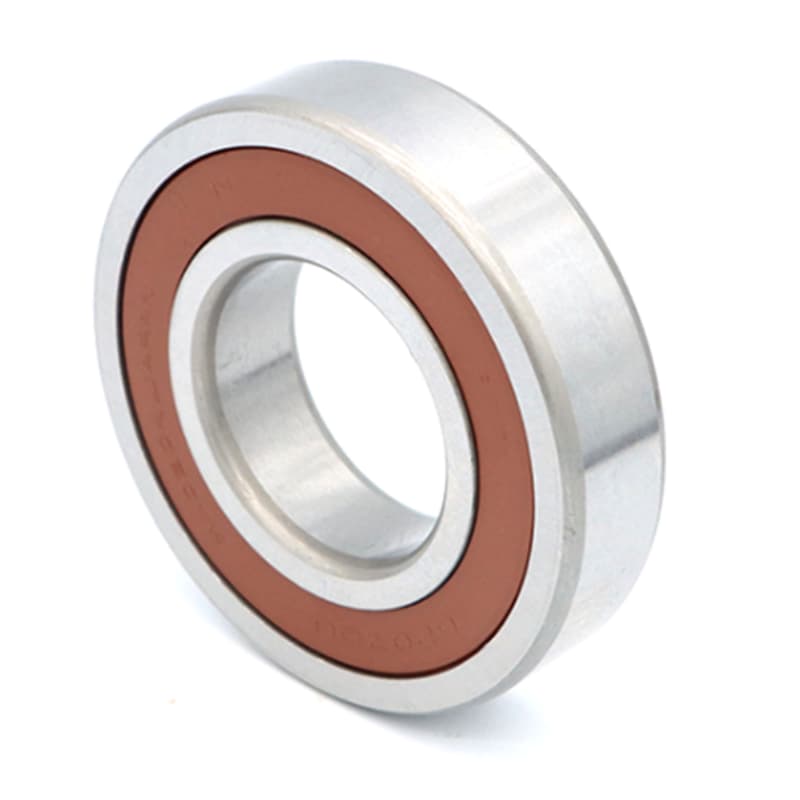
A Component-by-Component Guide for Harsh Environments
Each part has a specific function and a specific failure mode. Let’s look at each through the lens of mining durability.
1. Inner Ring1
- Function: It rotates with the shaft (usually). The deep groove raceway on its outside surface guides the balls.
- Mining Selection Focus: The bore tolerance2 must match the shaft fit (often k6 for a rotating inner ring). A loose fit causes creep and fretting corrosion. A too-tight fit can reduce internal clearance. The material must be through-hardened bearing steel (like GCr15) for toughness.
2. Outer Ring3
- Function: It is stationary (usually) in the housing. It has the matching deep groove raceway on its inside surface.
- Mining Selection Focus: The outside diameter tolerance must match the housing fit (often H7 for a stationary outer ring). For vibrating applications, a tighter fit might be needed to prevent rotation. Look for bearings with a spherical outside surface4 for self-aligning housings if alignment is a concern.
- Function: They are the rolling elements that transfer load from one ring to the other with minimal friction.
- Mining Selection Focus: The size, grade, and material of the balls are critical. More and larger balls increase load capacity. Ball grade (G10, G5) refers to sphericity and size variation; higher grade (G5) means smoother, quieter operation. In dirty environments, the balls are the first to be abraded by contaminants.
4. The Cage (Retainer)6
This is arguably the most critical component for high-stress applications and is often overlooked.
- Function: It spaces the balls evenly, prevents them from colliding, and guides them in and out of the load zone.
- Mining Selection Focus – Cage Material is Key:
- Pressed Steel Cage (J, Y): The most common and robust. Good for high temperatures and heavy loads. Excellent for most mining applications. It’s durable and cost-effective.
- Polyamide (Nylon) Cage (T, TN): Lightweight, allows higher speeds, and offers smoother running. But it has temperature limits (~120°C continuous) and can be brittle in cold or impacted by certain chemicals. Use with caution in hot or high-impact mining environments.
- Machined Brass Cage (M): Excellent for very high speeds and where lubricant compatibility is an issue. Good durability but more expensive. Used in high-performance applications.
- For Mining: A pressed steel cage7 is usually the safest, most durable choice for general quarry equipment, handling vibration and shock well.
| Part | Primary Role | Mining-Ready Specification Focus |
|---|---|---|
| Inner Ring1 | Rotates with shaft, carries load path. | Correct shaft fit (k6); hardened steel material. |
| Outer Ring3 | Stationary in housing, carries load path. | Correct housing fit (H7); consider spherical O.D. for alignment. |
| Ball Elements5 | Roll to transfer load with low friction. | Sufficient quantity/size for load; high grade (G5/G10) for smoothness. |
| Cage | Spaces and guides balls. | Choose Pressed Steel for toughness and temperature resistance. Avoid polyamide in hot/high-shock apps. |
When a bearing from a conveyor drive fails and the cage is shattered, it points to excessive vibration or shock. The corrective action might be to select a bearing with a more robust cage (steel instead of polyamide) or to address the source of the vibration. This component-level understanding turns a parts replacement into a reliability improvement.
Conclusion
Selecting deep groove ball bearings for mining requires matching their strengths (speed, versatility) to suitable applications (motors, gearboxes) while mitigating weaknesses (load capacity, misalignment sensitivity) through proper sizing, sealing, cage selection, and precise installation.
-
Understanding the Inner Ring’s role is crucial for selecting the right bearing for your application. ↩ ↩ ↩ ↩ ↩ ↩ ↩ ↩
-
Bore tolerance affects bearing fit and performance; learn how to choose the right specifications. ↩ ↩ ↩ ↩ ↩ ↩ ↩ ↩ ↩
-
Learn about the Outer Ring’s function to ensure proper fit and performance in your machinery. ↩ ↩ ↩ ↩ ↩ ↩
-
Explore how a spherical outside surface can enhance alignment and performance in bearings. ↩ ↩ ↩ ↩
-
Discover how Ball Elements reduce friction and enhance load capacity in bearings. ↩ ↩ ↩ ↩
-
The Cage is vital for bearing performance; understanding it can improve reliability in harsh conditions. ↩ ↩ ↩
-
A pressed steel cage offers durability and temperature resistance; essential for mining applications. ↩ ↩
-
Knowing the importance of C0 can prevent failures by ensuring that bearings are adequately rated for their intended loads. ↩ ↩