
Contamination in a food processing line is not just dirt; it’s a health hazard. A standard bearing can fail and introduce metal particles. Its grease can leak and contaminate product. This leads to costly recalls, production shutdowns, and damaged brand reputation. Food safety starts with component choice.
Food-grade deep groove ball bearings use corrosion-resistant stainless steel (AISI 304/316 or 440C) and are lubricated with NSF H1 registered greases that are safe for incidental food contact. Key variants include sealed types (e.g., 6203-2RS) with specific internal clearances (C3) to handle washdown thermal shocks, ensuring hygiene and reliability in food processing environments.
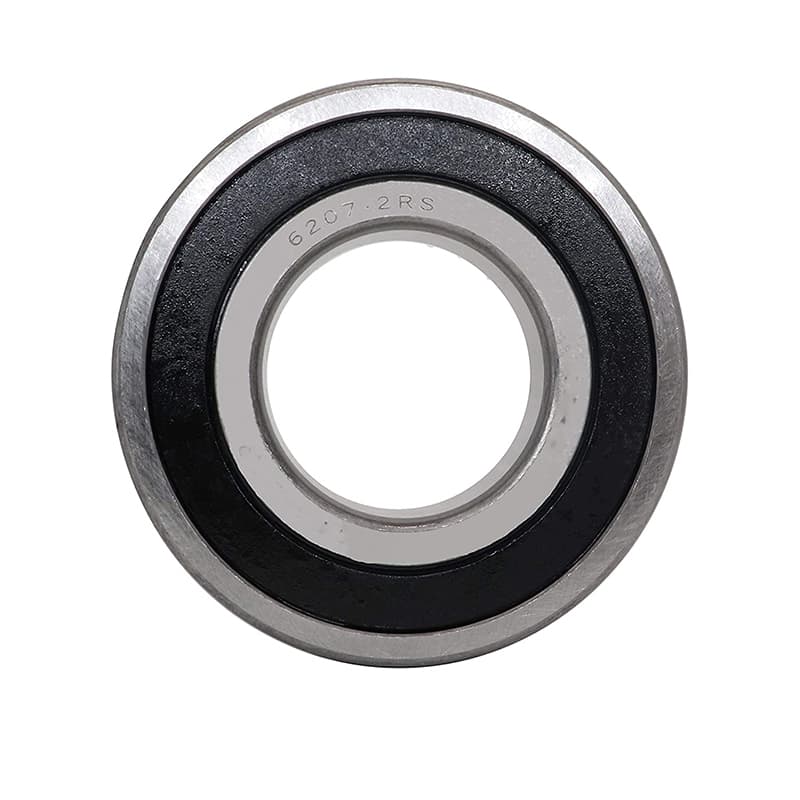
Selecting a bearing for food processing goes far beyond just picking a "stainless" option. The wrong grease or the wrong internal fit can cause as much trouble as the wrong material. Every specification, from grease type to dimensional tolerance, must align with the harsh reality of cleaning protocols and strict hygiene standards. Let’s examine these critical choices.
What kind of grease do you use on ball bearings?
Using the wrong grease is a common and critical mistake. Industrial greases can contain additives toxic to humans. In food applications, these greases can leak and contaminate products, causing serious safety violations. Even non-toxic greases can break down under high-pressure washdowns, leaving bearings unprotected.
For food-grade ball bearings, you must use NSF H1 registered grease1. H1 lubricants are certified for use in food processing areas where there is a possibility of incidental food contact. Common types are synthetic hydrocarbon (PAO) or silicone-based greases2 with aluminum complex or polyurea thickeners, designed to resist water washout and provide long life.
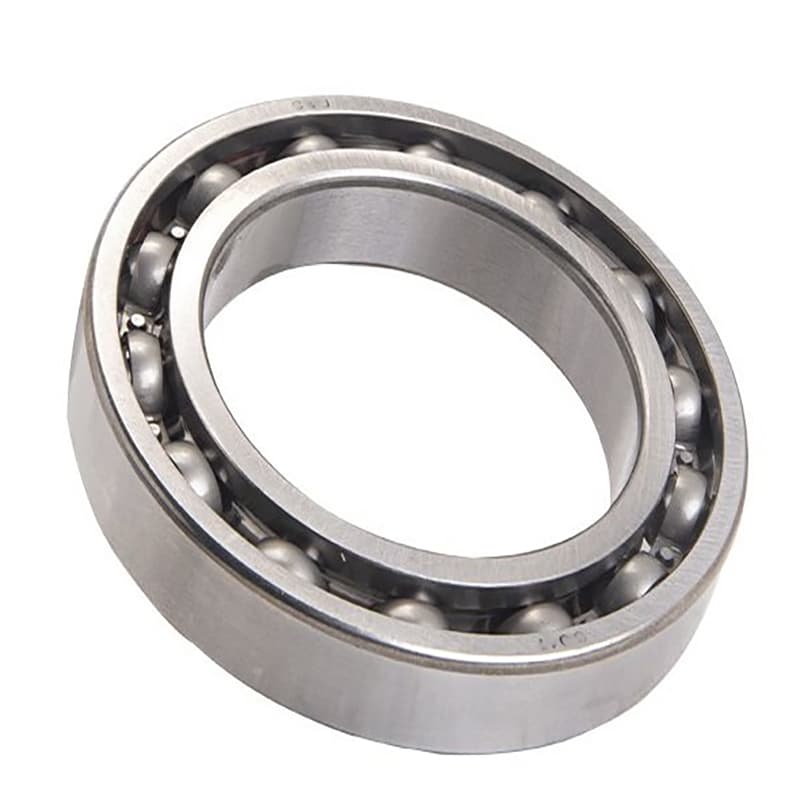
The Science of Safe Lubrication: Beyond "Food-Safe" Claims
The term "food-grade grease" is regulated. Not every non-toxic grease qualifies. The NSF (National Sanitation Foundation) H1 registration is the globally recognized standard. This grease must do more than be safe; it must also perform under punishing conditions.
Why NSF H1 Registration is Non-Negotiable:
- Safety Assurance: The formulation is reviewed and registered. It contains only ingredients approved for incidental food contact.
- Traceability: Registered products are listed in a public database. This provides documentation for food safety audits (like HACCP, ISO 22000).
- Performance Base: H1 greases are engineered to perform. They are not simple mineral oils.
Key Properties of High-Performance Food-Grade Greases:
Food processing environments are uniquely challenging. Greases must withstand:
- High-Pressure Washdowns: Grease must have excellent water resistance3 and not emulsify or wash out. Synthetic base oils and special thickeners (like aluminum complex) provide this.
- Wide Temperature Ranges: From cold storage to hot cooking areas or high-speed operation. The grease must remain stable (high dropping point4) and not thin out excessively.
- Corrosive Chemicals: Cleaners and sanitizers (chlorine, acids) can degrade grease. H1 greases are formulated to resist chemical attack.
Common Grease Types and Their Best Uses:
| Grease Type (Base Oil/Thickener) | Key Characteristics | Ideal Food Application |
|---|---|---|
| PAO (Synthetic Hydrocarbon) / Aluminum Complex | Excellent water resistance, high temperature stability, good lubrication. The most common high-performance H1 choice. | Mixers, conveyors, pumps, ovens – general high-demand areas. |
| Silicone / Silica Thickener | Wide temperature range, chemically inert. Lower load-carrying capacity. | Light-load, high-temperature areas like oven conveyor bearings. |
| Mineral Oil / Calcium Sulfonate Complex | Good water resistance and corrosion protection. | Older formulations, still used in some applications. |
At our FYTZ factory, we offer pre-greasing service5 as part of our OEM/ODM package. For a client building bakery mixers for export to Europe, we don’t just supply stainless steel bearings. We fill them with a specific, high-quality NSF H1 registered PAO-based grease that we have tested for performance. This ensures the machine builder delivers a fully compliant, ready-to-use component to their customer. For distributors like Rajesh, selling bearings pre-greased with the correct lubricant adds immense value and simplifies the supply chain for local food equipment repair shops.
What’s the difference between C3 and C41 bearings?
Internal clearance is a hidden but vital specification. In a food plant, bearings experience thermal shock from hot water or steam cleaning. A bearing with normal clearance can expand and become preloaded, leading to overheating and early failure. The wrong clearance choice sabotages the bearing’s life.
C3 and C41 refer to groups of internal radial clearance larger than the standard Normal (C0) clearance. C4 clearance is larger than C3. For food-grade applications, C3 is commonly specified to accommodate thermal expansion2 from heat (from process or cleaning) and prevent preload, which causes friction, heat, and premature failure.
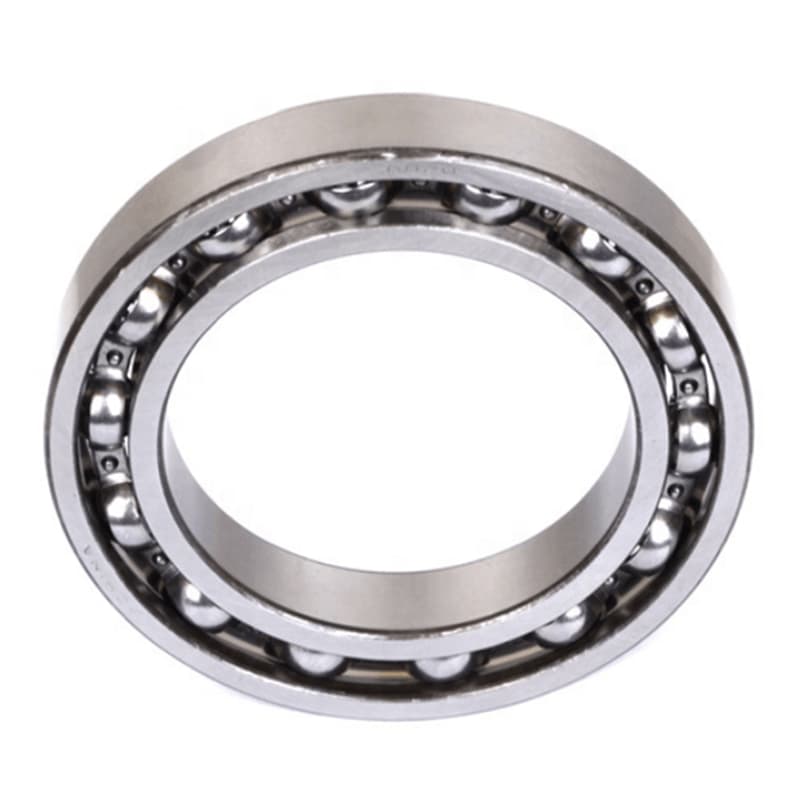
Managing Thermal Dynamics: The Role of Internal Clearance
Internal clearance is the measured space between the rolling elements and the raceways when the bearing is unmounted. It is not a manufacturing error; it is a deliberate design parameter. For food machinery, this parameter is often more important than in general industry due to thermal cycling.
Why Clearance Matters in Food Processing:
- Thermal Expansion: Stainless steel has a different coefficient of thermal expansion2 than carbon steel. More importantly, during CIP (Clean-in-Place)3 or SIP (Sterilize-in-Place) cycles, bearings are exposed to water or steam from 80°C to over 120°C. The inner ring, fitted on the shaft, heats up and expands faster than the outer ring in the housing. If there is insufficient clearance, this expansion takes up all the free space, creating axial preload. This drastically increases friction and temperature, causing grease breakdown and bearing seizure.
- Fit Considerations: Stainless steel bearings are often used with stainless steel shafts and housings. These fits can be tight. Adequate clearance compensates for this.
Understanding the Clearance Groups:
Clearance is measured in microns (µm). The groups are defined in ISO standards4.
| Clearance Designation | Description | Typical Application Context |
|---|---|---|
| C0 / Normal | Standard clearance. | General industrial use, stable temperatures. |
| C2 | Clearance smaller than Normal. | For applications requiring very precise shaft positioning, where preload is applied intentionally. |
| C3 | Clearance larger than Normal. | The most common choice for food-grade and other applications with moderate temperature variations or heavy loads. |
| C4 | Clearance larger than C3. | For applications with severe temperature gradients, or where fits are very tight. |
| C5 | Even larger clearance. | Special applications, like some paper machinery rolls. |
Selecting C3 vs. C4 for Food Machinery:
- Choose C3 for: Most applications – conveyors, mixers, pumps that undergo regular warm washdowns. It provides a good safety margin against thermal preload.
- Choose C4 for: Extreme cases – bearings directly in a steam path, applications with very high operational temperatures (e.g., near ovens, dryers), or where the housing/shaft fit is exceptionally tight.
For our clients, this is a key technical discussion. When a manufacturer of dairy processing equipment in New Zealand specifies bearings, they will likely call for "AISI 3045, sealed, C3 clearance, H1 grease." We at FYTZ understand this is not a random list; it’s a system designed for reliability under washdown. We manufacture and supply bearings to this exact specification. For a distributor, knowing that "C3" is often the correct default for food-grade inquiries helps them provide better technical guidance to their customers.
What are the types of 6203 bearings?
The 6203 is a size, not a single product. Assuming all 6203 bearings are the same leads to failures. A 6203 with plastic seals might be fine for a dry motor, but it will fail quickly in a wet food environment. The suffix codes define the critical differences.
The 6203 refers to a deep groove ball bearing with a 17mm bore, 40mm O.D., and 12mm width. Its "types" are defined by suffix codes for seals/shields (ZZ metal shield, 2RS rubber seal1), internal clearance (C3)2, material (SS for stainless steel), cage (J steel stamp, Y polymer), and precision class (P5, P6). For food-grade use3, common types are 6203-2RS C3 (stainless steel)4 or 6203-2RSH (stainless with H1 grease).
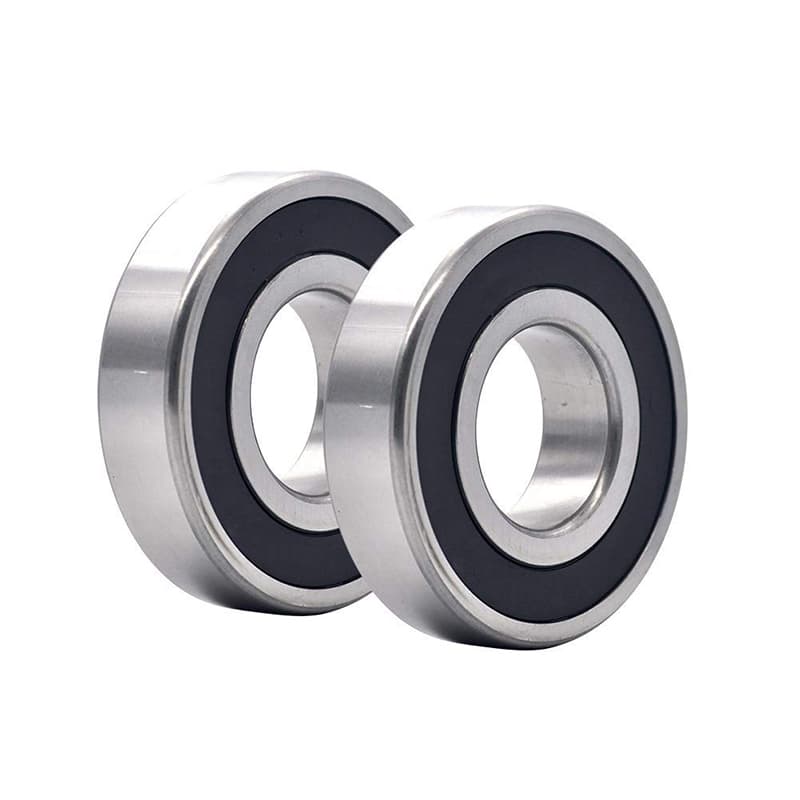
Navigating the Variants: Building the Right Bearing for the Job
The basic 6203 dimension is a canvas. The suffixes are the paint, creating bearings for vastly different applications. For food-grade use3, we combine specific suffixes to create a bearing that is hygienic, cleanable, and durable.
Let’s deconstruct the common suffix codes and build a food-grade 6203 step by step:
1. Sealing/Shielding (Critical for Contamination):
- ZZ: Two metal shields. Keeps large particles out and grease in. Not water-tight. Not suitable for washdown.
- 2RS: Two rubber contact seals (usually NBR). Provides much better protection against water and fine contaminants. The standard choice for food-grade applications. The rubber must also be food-safe (often FDA-approved nitrile).
2. Internal Clearance (As discussed, C3 is typical).
3. Material Designation:
- (No suffix): Usually indicates chrome steel (SAE 52100). Not food-grade.
- SS or AISI 440C: Martensitic stainless steel. Hard, corrosion-resistant. Common for food machinery.
- AISI 304/3165: Austenitic stainless steel. Softer, more corrosion/acid-resistant. Used where extreme corrosion resistance is needed over high load.
4. Cage (Retainer) Type:
- J: Pressed steel cage. Standard, robust.
- Y: Polyamide (plastic) cage. Lightweight, quiet running. Must be checked for compatibility with cleaning chemicals and temperature.
- M: Machined brass cage. Highest performance, resistant to chemicals and heat.
5. Special Lubrication:
- H or H1: Often indicates pre-greased with an H1 registered lubricant.
Building a Food-Grade 6203:
A typical specification might be: 6203-2RS C3 AISI 304
- 6203: Size.
- -2RS: Rubber seals for washdown protection.
- C3: Internal clearance for thermal cycling.
- AISI 304: Material for excellent corrosion resistance against acids, chlorine, and salts.
Comparison of common 6203 configurations:
| Bearing Designation | Key Features | Suitable For Food Processing? |
|---|---|---|
| 6203 ZZ | Shielded, carbon steel. | No. Not sealed, material will corrode. |
| 6203-2RS | Sealed, carbon steel. | Marginally better, but steel will rust. Not recommended. |
| 6203-2RS C3 SS | Sealed, stainless (440C), C3 clearance. | Yes. The standard, reliable choice for most areas. |
| 6203-2RSH C3 AISI 3166 | Sealed, 316 stainless, C3, H1 grease. | Yes. Premium choice for highly corrosive environments (e.g., pickle lines, seafood). |
At FYTZ, we can produce all these variants. For a client making citrus juicing equipment, we might recommend the AISI 316 version for its superior acid resistance. For a general conveyor builder, the standard 440C version is perfect. This ability to configure the exact bearing needed is a core part of our value to global equipment manufacturers and the distributors who supply them.
What material are deep groove ball bearings made of?
The bearing material is its foundation. A carbon steel bearing in a dairy plant will rust from lactic acid and washdowns, contaminating the product with iron oxide. The material choice directly dictates the bearing’s suitability for any environment, especially food.
Standard deep groove ball bearings are primarily made from high-carbon chromium steel (SAE 52100 or equivalent ISO 100Cr6)1. For corrosion-resistant applications, they are made from martensitic stainless steel (AISI 440C)2 or austenitic stainless steel (AISI 304, 316)3. Other materials include ceramics (Si3N4, ZrO2)4 for full ceramic bearings, or plastic (PEEK, PA66) for very light duty.
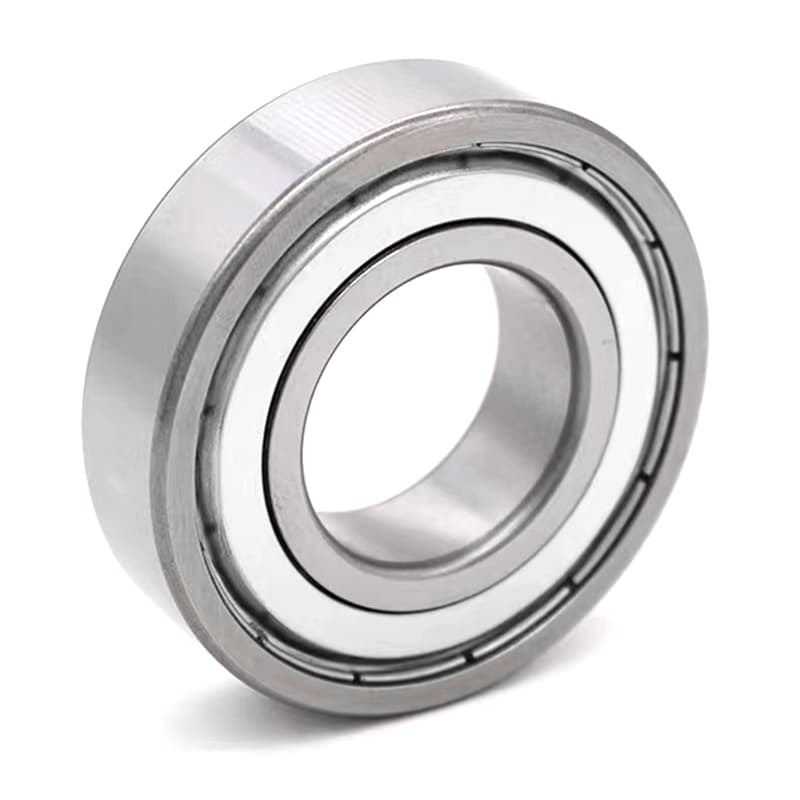
From Forging to Performance: How Material Defines Capability
The material choice affects everything: load capacity5, wear resistance, corrosion resistance6, temperature limits, and cost. It’s not just about "stainless vs. steel." The specific alloy and its heat treatment process7 are what create the final bearing properties.
1. High-Carbon Chromium Steel (SAE 52100):
- Process: Forged or turned from bar stock, then through-hardened. Heated and quenched to achieve a uniform high hardness (typically 58-64 HRC) throughout.
- Properties: Excellent wear resistance and high load capacity5. The industry standard for most general industrial applications.
- Limitation: Prone to corrosion. Requires protective environments or coatings.
- Not suitable for food-grade applications in direct or splash zones.
2. Martensitic Stainless Steel (AISI 440C):
- Process: Similar to 52100, but with a higher chromium content (16-18%). It can be through-hardened to similar high hardness levels.
- Properties: Good corrosion resistance6 (resists rust from water, mild acids, alkalis), combined with good load capacity5 and wear resistance.
- Food-Grade Use: The most common material for food-grade bearings8 where both corrosion resistance6 and mechanical strength are needed. It is harder and more wear-resistant than 304/316.
3. Austenitic Stainless Steel (AISI 304, 316):
- Process: Cannot be hardened by heat treatment like 440C. They gain strength through cold working.
- Properties: Superior corrosion and chemical resistance compared to 440C, especially AISI 316 with molybdenum. Softer and has lower load capacity5.
- Food-Grade Use: Used in applications where corrosion is the primary concern over heavy load, such as in highly acidic environments or where chlorine-based sanitizers are used.
Material Selection Guide for Food Environments:
| Material | Best Used in Food Applications For… | Key Limitation |
|---|---|---|
| AISI 440C (Stainless) | General food machinery: Conveyors, mixers, pumps, packaging. Areas with washdowns and moderate loads. | Can still corrode in highly acidic or chlorine-rich environments over time. |
| AISI 304 (Stainless) | Applications with frequent exposure to organic acids (fruit, dairy) or less demanding load conditions. | Lower load rating than 440C. |
| AISI 316 (Stainless) | The most aggressive environments: seafood processing, high-salt or high-chlorine sanitizer use, pickling lines. | Lowest load rating of the stainless steels; highest cost. |
| Ceramic (Si3N4) | Extreme corrosion or where non-magnetic, electrically insulating properties are required. | High cost, can be brittle under shock load. |
At FYTZ, we source specific grades of stainless steel billets for our food-grade bearing production. Our heat treatment lines are calibrated for 440C to achieve the optimal hardness. We understand that a bearing for a chocolate tempering machine (moderate acid, high load) might best use 440C, while one for a brine injection needle in meat processing might require 316. This material expertise, combined with our greasing and clearance capabilities, allows us to deliver complete, reliable food-grade bearing solutions to our global B2B partners.
Conclusion
Specifying food-grade deep groove ball bearings requires a system approach: pairing corrosion-resistant stainless steel (440C/304/316) with NSF H1 grease, appropriate internal clearance (C3), and effective sealing (2RS) to ensure hygiene, durability, and compliance in food processing.
-
Explore the properties of this steel to understand its applications and benefits in various industries. ↩ ↩ ↩ ↩ ↩
-
Learn how AISI 440C offers corrosion resistance and strength, making it ideal for food-grade applications. ↩ ↩ ↩ ↩ ↩
-
Discover the unique properties of these stainless steels and their suitability for different environments. ↩ ↩ ↩ ↩ ↩
-
Find out how ceramics can enhance performance in extreme conditions and their advantages over metals. ↩ ↩ ↩ ↩
-
Learn about the importance of load capacity in selecting the right bearing for specific applications. ↩ ↩ ↩ ↩ ↩ ↩ ↩
-
Explore the key factors that determine how well bearing materials resist corrosion in various environments. ↩ ↩ ↩ ↩
-
Discover how heat treatment enhances the properties of bearing materials, leading to better performance. ↩
-
Understand the significance of food-grade bearings in maintaining hygiene and safety in food processing. ↩