
A critical machine is down. You have an SKF 22208 bearing that needs replacing. Your supplier only has FAG or FYTZ in stock. Can you use them? Cross-referencing seems simple, but a direct part number swap can lead to failure if you don’t understand the underlying standards and subtle design differences.
Yes, you can reliably cross-reference spherical roller bearings across brands like SKF, FAG, NSK, and FYTZ because they adhere to common ISO dimension standards (ISO 15). However, you must also verify matching specifications for internal clearance, tolerance class, cage type, and any special suffixes to ensure full functional compatibility.
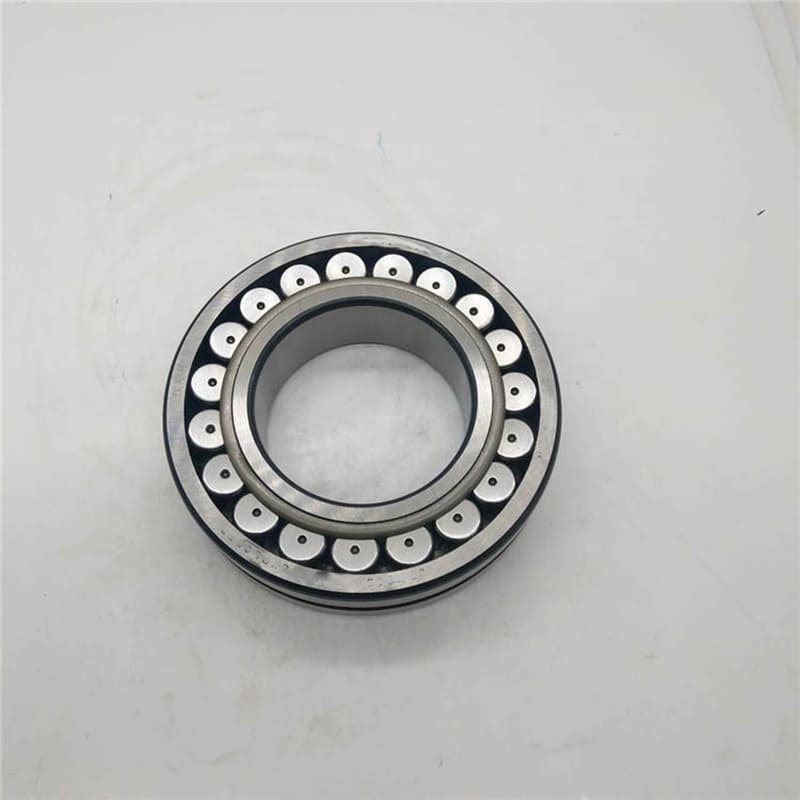
Successful cross-referencing is more than finding the same basic number. It requires understanding the universal language of bearings (ISO standards), knowing what different bearing types are, deciphering common codes like "Z", and recognizing the main variants within the spherical roller bearing family itself. Let us break it down.
What is the ISO standard for spherical roller bearings?
When a buyer asks for cross-reference1, the first thing I check is the ISO standard. This is the common rulebook that makes cross-referencing possible between brands. Without it, every bearing would be a unique size, and replacement would be chaos.
The fundamental ISO standard for spherical roller bearing interchangeability is ISO 15:20172. It specifies the boundary dimensions (bore, outer diameter, width), chamfer dimensions, and the method for calculating basic load ratings. Compliance ensures that a 22210 bearing from any manufacturer has the same core dimensions.
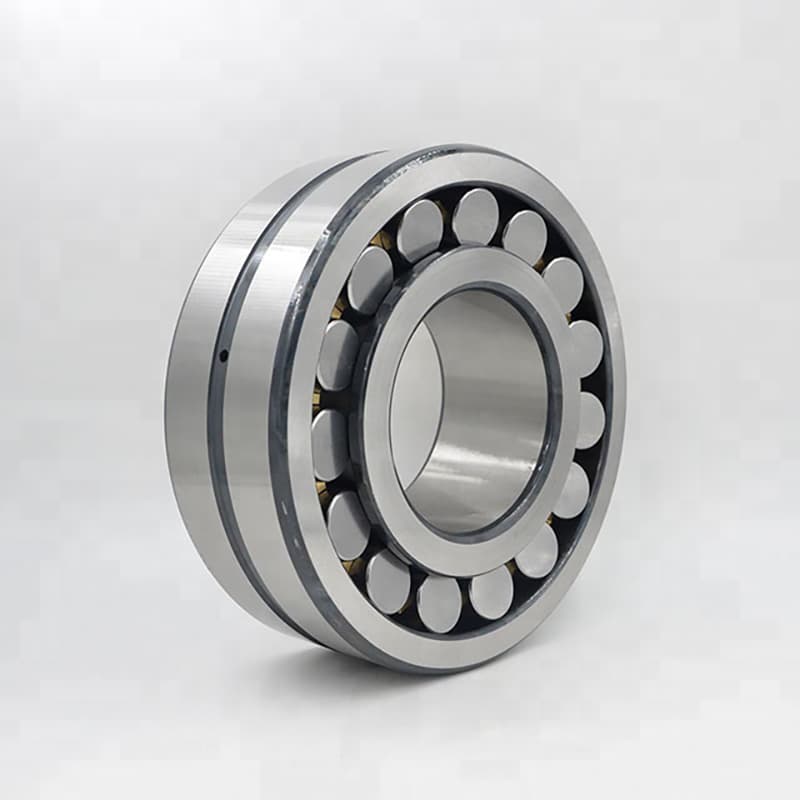
The ISO Framework: The Foundation of Interchangeability
ISO 15 is the starting point, but it is part of a larger system. For true functional cross-referencing, you need to understand the full suite of standards that define a bearing’s characteristics.
1. ISO 15:20172 – The Dimensional Passport
This standard gives the bearing its basic identity. For a spherical roller bearing, the designation (e.g., 22210) is defined here:
- The first digit/s (2) often indicates the type (spherical roller).
- The second digit/s (22) indicates the dimension series (width and outer diameter profile).
- The last two digits (10) give the bore diameter in mm (10 * 5 = 50mm bore).
If a manufacturer’s 22210 bearing does not match the ISO 15 dimensions, it is not a true cross-reference1. This is the first and non-negotiable check.
2. ISO 492:20143 – The Tolerance Classifier
Dimensions have tolerances. ISO 492 defines these tolerance classes for radial bearings: Normal (P0), P6, P5, P4, etc.
- A bearing might be marked as 22210 P6. The "P6" refers to ISO 492, meaning it has tighter dimensional and running accuracy tolerances than a standard P0 bearing.
- When cross-referencing, you must match the tolerance class. Replacing a P6 bearing with a P0 bearing might cause vibration or misalignment in a precision application.
3. ISO 5753-1:20094 – The Clearance Guide
Internal clearance is critical. ISO 5753 defines the standard ranges: C2, CN (Normal), C3, C4, C5.
- A bearing marked 22210 C3 has a specific range of internal radial clearance.
- You must match the clearance group. Using a C4 bearing where a C3 is specified can lead to excessive play and noise.
4. Material & Performance Standards
While not always in the part number, these are verified by manufacturer certificates:
- Material Standards5: Reference standards like ISO 683-17 for steel quality.
- Vibration Standards6: ISO 15242 for vibration grades (Z, V1, V2, etc.).
| Standard | Governs | Inscription Example | Cross-Reference Rule |
|---|---|---|---|
| ISO 15:20172 | Boundary Dimensions | 22210 | MUST MATCH. This is the base number for size. |
| ISO 492:20143 | Tolerance Class | 22210 P6 | Should match for precision applications. P0 can sometimes substitute for non-critical uses. |
| ISO 5753-1:20094 | Internal Clearance | 22210 C3 | MUST MATCH for correct operating performance. |
| ISO 15242 | Vibration Level | (Not usually in PN, on report) | Match if specified (e.g., for electric motors). |
So, when Rajesh gets a request for an "SKF 22210 E/C3", he knows to look for a bearing that meets:
- ISO 15 size for 22210.
- C3 clearance per ISO 5753.
- The "E" might be an SKF-specific design suffix (like their strengthened internal design). For a direct cross-reference1, he would need to find a competitor’s equivalent "optimized" series or ensure the standard series has sufficient load rating. This is where deep catalog knowledge or a good cross-reference1 database is essential.
What are crossed roller bearings1?
This is a common point of confusion. The names sound similar, but "spherical roller bearing2" and "crossed roller bearing" are completely different products with different purposes. Mixing them up during cross-referencing would be a critical error.
Crossed roller bearings are a distinct type of precision bearing where cylindrical rollers are arranged crosswise (at 90°) between two raceways. They are compact, provide very high rigidity3 and accuracy for combined loads, but have lower load capacity4 and are not self-aligning like spherical roller bearing2s.
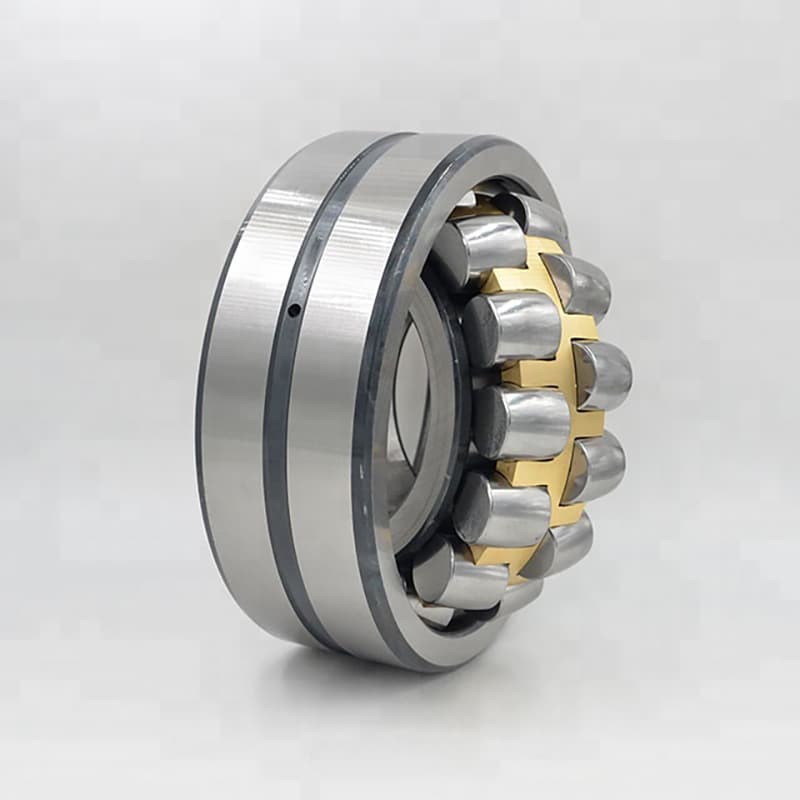
Crossed Roller Bearings: Precision vs. Robustness
As a manufacturer of spherical roller bearing2s, I respect crossed roller bearings1 for their niche. Let us clarify the differences to avoid costly substitution mistakes.
Design and Principle:
- Spherical Roller Bearing: Has two rows of barrel-shaped rollers. The rollers are guided by a center flange on the inner ring. The design allows for self-alignment5 (the inner ring and rollers can pivot inside the outer ring) to accommodate shaft misalignment.
- Crossed Roller Bearing: Has a single row of cylindrical rollers. Each roller is positioned at a 90-degree angle to its neighbor. The rollers alternate their axis orientation. This "X" pattern allows a single bearing to directly handle radial, axial, and moment loads simultaneously without the need for a bearing pair.
Key Characteristics Comparison:
| Feature | Spherical Roller Bearing | Crossed Roller Bearing |
|---|---|---|
| Roller Type | Barrel-shaped (two rows) | Cylindrical (single row, crossed) |
| Self-Alignment | Yes (Typically ±2-3°) | No |
| Load Capacity | Very High radial and moderate axial | Moderate radial and axial, but high moment load capacity |
| Rigidity | Good | Exceptionally High |
| Precision & Accuracy | Standard to High (P0, P6) | Very High Precision (P5, P4, P2 common) |
| Cross-Section | Relatively wide | Very Compact (saves space) |
| Typical Applications | Heavy machinery, vibrating screens, gearboxes. | Robotics arms, rotary tables, machine tool indexing heads, medical scanners. |
Why You Cannot Cross-Reference Them:
Imagine you need a bearing for a crane sheave. The shaft will deflect. You need a spherical roller bearing2 for its self-alignment5 and high radial capacity. If you mistakenly install a crossed roller bearing, it will fail quickly because:
- It cannot align with the shaft deflection.
- Its load capacity4 is likely insufficient for the heavy radial load.
- It is a precision component6 not designed for harsh, dirty environments.
Conversely, using a spherical roller bearing2 on a robot arm would result in poor positioning accuracy and excessive deflection due to lower rigidity.
For a distributor, this knowledge prevents a major error. If a customer provides a part number for a crossed roller bearing (often starting with something like CRB, XRB, or RX), Rajesh’s team must know it is not interchangeable with a standard spherical roller bearing2 series like 222 or 213. They belong to different worlds of application.
What do z and zz mean on a bearing?
These are some of the most common suffixes you will see on bearing codes1. They are not part of the core ISO size designation, but they are critical for cross-referencing2. "Z" and "ZZ" specify a standard feature that must be matched to ensure the bearing functions correctly in its intended environment.
The suffix "Z" on a bearing indicates a single metal shield (or seal) on one side. The suffix "ZZ" indicates two metal shields3, one on each side. Shields are non-contact metal plates that provide basic protection against large contaminants while allowing high-speed operation.
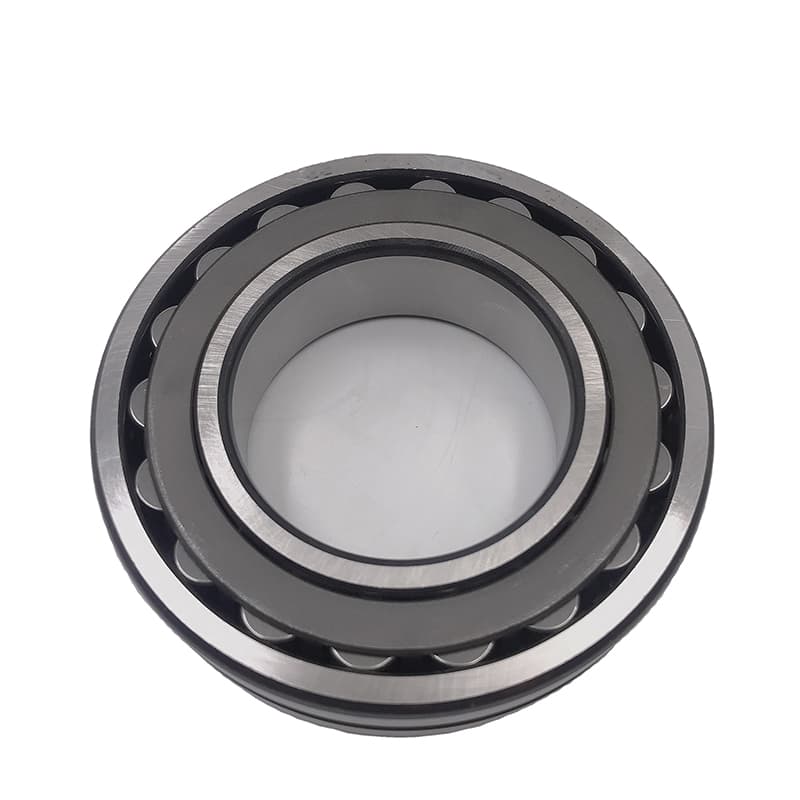
Decoding Suffixes: Shields, Seals, and More
Suffixes like Z and ZZ are part of a standardized "suffix system" used by many manufacturers. They describe modifications to the standard bearing design. Getting the suffix wrong during cross-referencing2 can affect lubrication retention4 and contamination exclusion.
Understanding Shields (Z, ZZ):
- Material & Function: A shield is a thin metal plate (usually steel) stamped and fixed into a groove on the outer ring. It has a very small running gap between itself and the inner ring. It does not make contact.
- Purpose: Its main job is to keep large particles (like dirt chunks) from entering the bearing. It also helps to retain grease inside the bearing. However, because it is non-contact, it does not create friction and is suitable for very high speeds.
- Limitation: It is not effective at keeping out fine dust or liquids. It is a basic protective measure.
Related Common Suffixes for Sealing:
- RS or 2RS: This indicates a contact seal5 made of rubber (NBR or FKM). "RS" is one side, "2RS" is two sides. The seal rubs against a land on the inner ring, providing much better protection against dust and moisture. However, the friction limits the maximum speed compared to a shielded bearing.
- RZ or 2RZ: This indicates a low-friction seal, a hybrid design. It has a rubber coating on a steel shield, providing better sealing than a plain Z shield but with less friction than a full RS contact seal5.
Cross-Referencing Rules for Suffixes:
- Match the protection level: If the original bearing is ZZ (shielded on both sides), the replacement should also be ZZ. Do not replace a 2RS (sealed) bearing with a ZZ bearing if the environment is wet or dusty.
- Consider lubrication: Shields and seals affect relubrication. Most 2RS bearings are "sealed for life6" and cannot be relubricated. ZZ bearings often have a relubrication groove and hole, allowing fresh grease to be added.
- Check speed rating7: The bearing catalog will list different speed rating7s for open, shielded (Z/ZZ), and sealed (RS/2RS) versions of the same base bearing. The sealed version has the lowest speed limit.
| Suffix | Meaning | Protection Level | Speed Capability | Relubricatable? |
|---|---|---|---|---|
| (No suffix) | Open Bearing | None | Highest | Yes |
| Z / ZZ | Single / Double Metal Shield | Basic (large debris) | Very High | Usually Yes (if design allows) |
| RS / 2RS | Single / Double Contact Rubber Seal | Good (dust, moisture) | Lower (due to friction) | Usually No ("sealed for life6") |
| RZ / 2RZ | Single / Double Low-Friction Seal | Better than Z, worse than RS | Between Z and RS | Usually No |
For example, if a customer needs an FAG 22210-2RS for a dusty agricultural gearbox, Rajesh cannot cross-reference it with a generic 22210 (open) or a 22210-ZZ. The open bearing would get contaminated quickly. The ZZ bearing would not keep fine dust out. He must find a 22210 bearing with 2RS seals, or at minimum, advise the customer of the performance difference if only a shielded version is available. This attention to suffix detail is what defines a professional bearing supplier.
What are the different types of spherical roller bearings1?
Not all spherical roller bearings1 are the same. Even within this family, there are important design variations that affect performance and suitability. Cross-referencing requires you to match not just the size, but also the correct type of spherical roller bearing.
The main types of spherical roller bearings1 are defined by their internal design: symmetrical vs. asymmetrical rollers2s](https://blog.emersonbearing.com/blog/split-roller-bearings-benefits)[^3], and by their cage type (pressed steel, polyamide, or brass). Common series include the 222 series (heavy duty), 223 series (extra heavy duty), and 213 series (medium duty with narrower width).
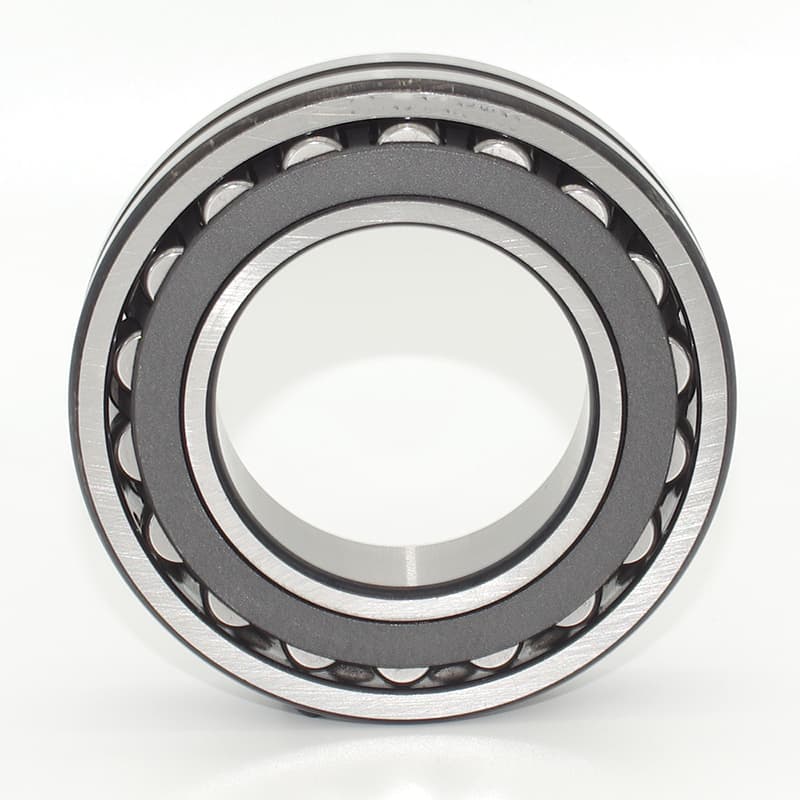
Navigating the Spherical Roller Bearing Family Tree
When you look up a part number like "SKF 22210 E/C3", the "222" tells you the series, and the "E" might be a design variant. Understanding these differences is crucial for accurate cross-referencing.
1. Classification by Internal Design & Roller Shape:
- Standard (Asymmetrical) Rollers: This is the traditional and most common design. The rollers have an asymmetrical (barrel) shape. They are guided by a center flange on the inner ring. This design is robust and handles high loads well.
- Symmetrical Rollers (Optimized Design): Some manufacturers, like SKF (with their "E" suffix design), use symmetrical rollers3. This design often allows for more rollers to be fitted, increasing load capacity. It also can reduce internal friction. When cross-referencing an "E" type bearing, you need to ensure the alternative brand’s standard series has a comparable or higher load rating, or see if they have an "optimized" series of their own.
2. Classification by Dimension Series (The "Width & Profile" Code):
This is the 2 or 3 digit code after the type indicator.
- Series 2134: "2" for spherical, "13" for dimension series. This is a medium series, often with a narrower width. Example: 21308.
- Series 2225: "22" is the dimension series. This is a heavy series, the most common general-duty type. Example: 22210.
- Series 223: "23" is the dimension series. This is an extra-heavy series, with greater width and outer diameter for the same bore, offering even higher load capacity. Example: 22310.
Important: A 22210 and a 22310 have the same 50mm bore, but different outer diameters and widths. They are NOT interchangeable. The housing and shaft seating would be different.
3. Classification by Cage Type:
The cage holds the rollers. Different cages suit different applications.
- Pressed Steel Cage (J): The most common, indicated often by a suffix "J" or "Y". Robust, good for high speeds and temperatures.
- Glass Fiber Reinforced Polyamide Cage (T): Suffix "T". Lighter, allows higher speeds, offers smoother running and is tolerant of momentary lubrication loss. Has temperature limits (~120°C continuous).
- Machined Brass Cage (M): Suffix "M". Used for very high-speed applications or where lubricant compatibility is an issue. Excellent durability and heat dissipation.
| Series & Type | Key Feature | Load Capacity | Typical Suffix Examples | Cross-Reference Focus |
|---|---|---|---|---|
| 213 Series | Narrow width, compact | Medium | 21308 C3 (Standard) | Match dimension series (213) and bore. Check if load is sufficient. |
| 222 Series | Standard heavy duty | High | 22210 E/C3, 22210-2RS | Match series (222) and bore. For "E", verify load rating match. |
| 223 Series | Extra heavy duty, wider | Very High | 22310 C3 | Match series (223) and bore. Do not mix with 222. |
| Cage: Pressed Steel | Robust, general purpose | – | (J), or no suffix | Most common. Direct match usually fine. |
| Cage: Polyamide (PA66) | High speed, smooth run | – | T, TN9 | Match if high speed is critical. Note temperature limits. |
For Rajesh’s cross-referencing work, this means a request for an NSK 22210CAME4 needs to be decoded:
- 22210: ISO size (Series 2225, 50mm bore).
- CAM: Likely NSK’s code for their internal design and cage (maybe brass cage6).
- E4: Could indicate C3 clearance and other features.
His job is to find a bearing that matches the 22210 C3 core requirement and then assess if his supplier’s standard 22210 C3 with a pressed steel cage7 is a suitable replacement, or if he needs to source one with a brass cage6 for high-speed compatibility. This level of detail ensures the replacement works correctly.
Conclusion
Cross-referencing spherical roller bearings successfully requires matching the ISO dimensional base, critical specifications like clearance and tolerance, understanding suffix codes, and recognizing different internal types. This systematic approach ensures compatibility and prevents costly machine downtime.
-
Explore this link to understand the various applications and benefits of spherical roller bearings in different industries. ↩ ↩ ↩ ↩ ↩ ↩ ↩ ↩ ↩ ↩
-
Learn about the benefits of asymmetrical rollers, including their load handling capabilities and design robustness. ↩ ↩ ↩ ↩ ↩ ↩ ↩ ↩ ↩ ↩ ↩ ↩
-
Discover how symmetrical rollers can enhance load capacity and reduce friction in bearing applications. ↩ ↩ ↩ ↩ ↩
-
Find detailed specifications and applications for Series 213 bearings, ideal for medium-duty uses. ↩ ↩ ↩ ↩ ↩ ↩
-
Explore the features of Series 222 bearings that make them a popular choice for heavy-duty applications. ↩ ↩ ↩ ↩ ↩ ↩ ↩
-
Discover the advantages of brass cages in bearings, particularly in high-speed and high-temperature environments. ↩ ↩ ↩ ↩ ↩ ↩
-
Understand why pressed steel cages are commonly used in bearings and their advantages in high-speed applications. ↩ ↩ ↩
