
Your machine design is perfect, except for one part. The standard bearing size doesn’t fit. Or the operating environment is too harsh for a normal bearing. You’re stuck. This is where off-the-shelf solutions end, and the real engineering partnership begins.
Customized deep groove ball bearings are modified from standard designs to meet unique needs. This includes non-standard dimensions (ID, OD, width), special materials (stainless steel, ceramic), altered tolerances (P5, P4), unique seals/shields, special lubrication, and coatings for corrosion or high-temperature resistance.
Standard bearings solve common problems. But many industrial challenges are not common. Customization is the bridge between a theoretical design and a reliable, working machine. For OEMs and innovators, it’s not a luxury; it’s a necessity. Let’s explore the fundamentals of this versatile bearing and how we can tailor it.
What is a deep groove ball bearing1?
Look inside almost any rotating device, from a small electric screwdriver to a large industrial pump. You will likely find this bearing. It is the most common type of rolling bearing in the world. Its simple design hides sophisticated engineering.
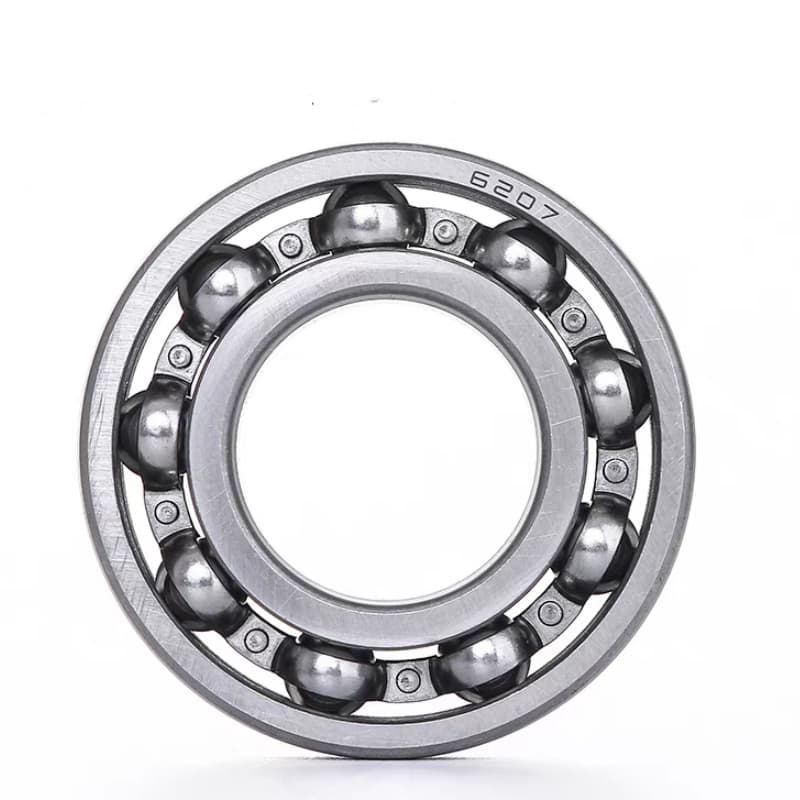
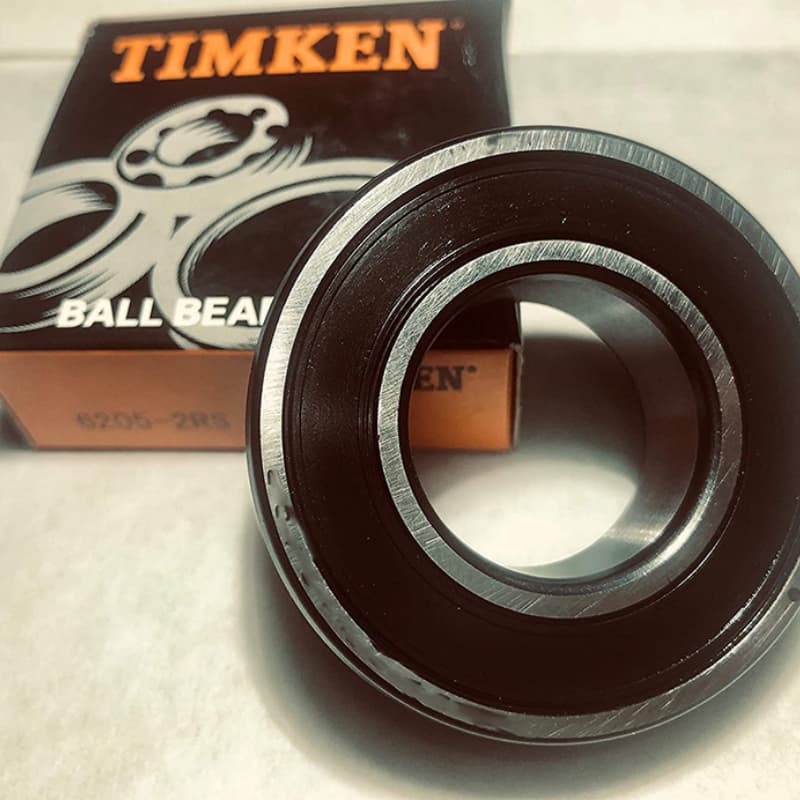
A deep groove ball bearing1 is a rolling-element bearing with an inner ring, an outer ring, a set of steel balls, and a cage to separate the balls. It is called "deep groove" because the raceways on both rings are deep, continuous arcs. This design supports radial and axial loads from both directions.
The Anatomy of a Workhorse
To understand customization2, we must first understand the standard part. Every component of a deep groove ball bearing1 has a specific purpose and can be modified.
1. The Rings (Inner and Outer)
These are the tracks for the balls. The deep, continuous grooves (raceways) are precisely machined. The depth and curvature are critical for load capacity and contact angle. In customization2, we can change the ring material, the hardness, or the dimensions (like a thicker outer ring for more strength).
2. The Balls
These are the rolling elements. They are made from high-grade, hardened steel and are precision-ground to a near-perfect sphere. Customization can involve different ball materials (like ceramic for electrical insulation or high-speed applications), different ball sizes (affecting load capacity), or even different quantities.
3. The Cage (Retainer)
This component separates the balls, keeps them evenly spaced, and guides them. Standard cages are often steel stampings or polymer (like nylon). For customization2, cages can be made from brass, phenolic resin, or other special materials for high-speed, high-temperature, or chemically aggressive environments.
4. The Seals/Shields
These are optional add-ons to protect the bearing.
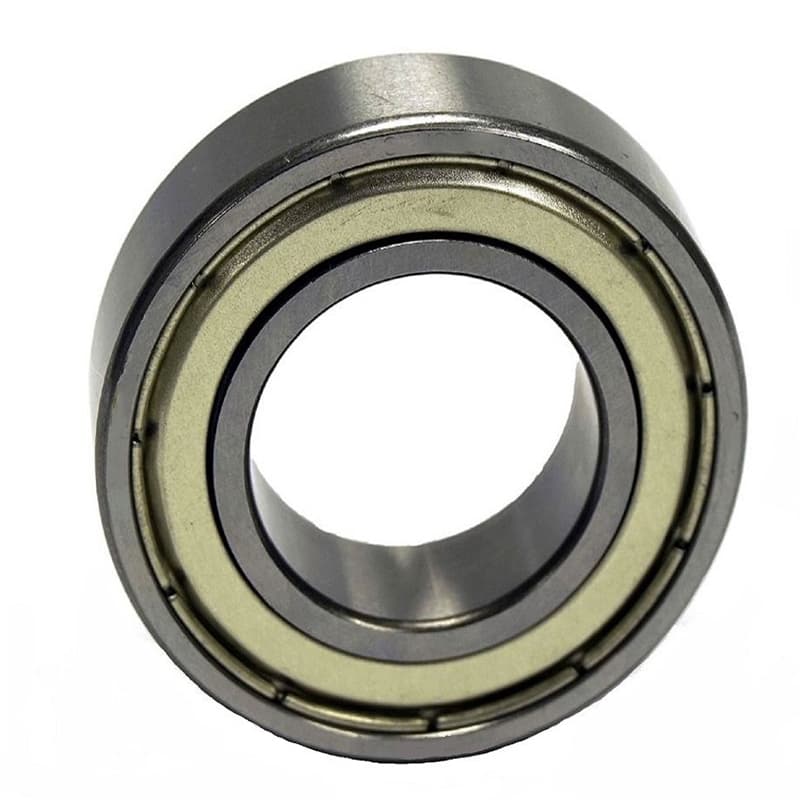
- Shields (ZZ): Thin metal plates that keep large debris out but allow grease to stay in. They offer minimal friction.
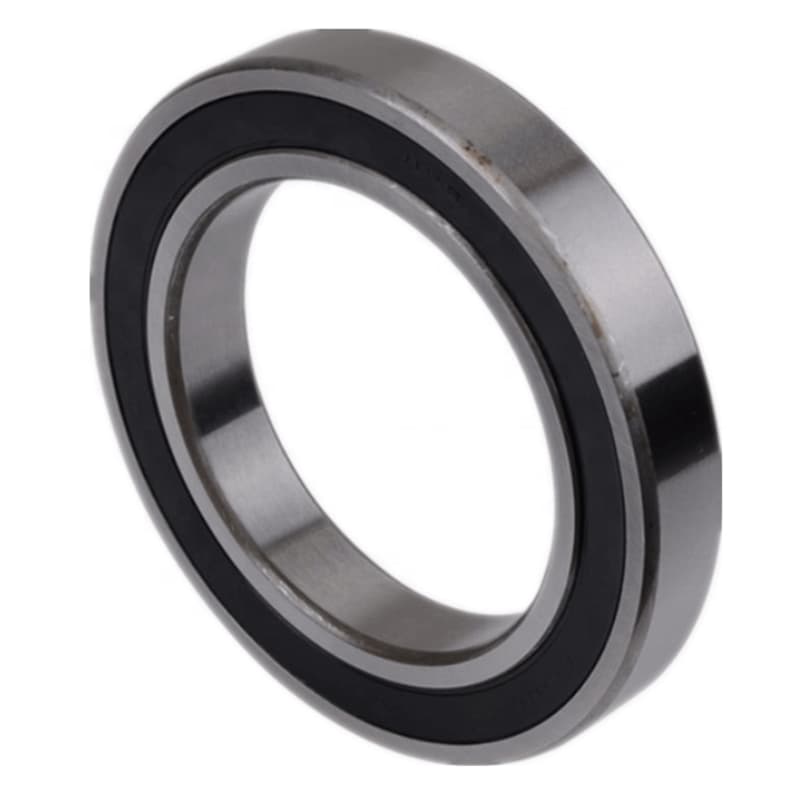
- Seals (2RS): Rubber-contact seals that provide better protection against dust and moisture but create slightly more friction.
Custom seals can be made from specific elastomers (like Viton for high heat or chemicals) or designed as non-contact labyrinths for very high speeds.
The beauty of this design is its adaptability. Each of these four core components—rings, balls, cage, seals—is a variable an engineer can adjust. At FYTZ, when a customer from Russia’s automotive sector or Indonesia’s food processing industry approaches us with a problem, we start by asking which of these components is failing or needs to change. This systematic approach turns a customization2 request into a solvable engineering equation3.
What are the advantages of deep groove ball bearings?
Why is this bearing so ubiquitous? The answer lies in a powerful combination of advantages that make it the default choice for countless applications. When you understand these strengths, you can better decide when to use a standard version and when to customize one.
The key advantages of deep groove ball bearings are their versatility in handling combined radial and axial loads, their ability to run at high speeds, their low friction and torque, their simple and robust design for easy installation, and their overall cost-effectiveness for a wide range of applications.
Breaking Down the Strengths That Enable Customization1
These advantages are not accidental. They stem from the deep groove geometry and the point contact of the balls. Let’s examine each advantage and see how it forms a foundation for specialized variants.
1. Versatility in Load Handling2
This is the primary advantage. The deep groove geometry allows the bearing to support not just radial loads (perpendicular to the shaft), but also significant axial loads (parallel to the shaft) in both directions. Many other bearing types can only handle axial load in one direction or require pairs. This makes the deep groove ball bearing a compact, all-in-one solution. Customization1 can amplify this: using larger balls or a different groove curvature can increase axial load capacity for a specific thrust-heavy application.
2. High-Speed Capability3
Due to the low friction of ball rolling and the possibility of using lightweight cages, deep groove ball bearings can achieve very high rotational speeds. This is critical for machine tool spindles, electric motors, and turbochargers. Customization1 for high speed might involve ceramic balls (lighter, reduce centrifugal force), special high-precision cages, or a tailored lubrication system.
3. Low Friction and Torque4
The rolling motion of balls creates less friction than sliding contact. This means higher mechanical efficiency, less energy loss as heat, and lower starting torque. In applications where energy savings are critical, or where a small motor must overcome startup inertia, this is vital. Custom seals can be designed to further minimize friction drag.
4. Simple and Robust Design5
The design is symmetrical and relatively simple. This makes it easy to manufacture to high precision, easy to install (non-directional), and inherently robust. This simplicity also makes it easier to customize. Changing a dimension or material doesn’t require a complete re-engineering of the bearing concept.
5. Cost-Effectiveness6
Mass production of standard sizes brings the unit cost down significantly. Even for many customizations, starting from this mature, efficient manufacturing base is more economical than designing a completely new bearing type from scratch.
For a machinery manufacturer or an importer like Rajesh’s company, these advantages translate directly into design flexibility and cost savings. When an OEM customer in Brazil is designing a new compressor, they might start with a standard deep groove ball bearing for its versatility and cost. If they need it to run quieter, Rajesh can propose a FYTZ customized version with P5 precision grade and special grease. The core advantages remain, but the performance is enhanced. This makes customization a logical, value-adding step.
What is the difference between deep groove and shallow groove ball bearings?
The name gives the first clue: the depth of the raceway groove. But this simple geometric difference creates a dramatic functional divergence. Choosing the wrong one can lead to rapid bearing failure1. It’s a fundamental distinction.
The core difference is the raceway depth and curvature. Deep groove bearings have deep, continuous arcs allowing them to handle significant axial loads2 from both directions. Shallow groove (or "Conrad" or "filling slot") bearings have shallower grooves and are primarily for radial loads; any axial load can cause the balls to skid or climb out.
When Geometry Dictates Function
The groove isn’t just a track; it’s a constraint system that governs how the balls behave under load. Understanding this physics explains why deep groove bearings3 are the workhorse for customization.
The Deep Groove: A Constrained Highway
Imagine the deep groove as a deep, U-shaped highway for the balls. When an axial load is applied, the balls are pushed against the side of the groove. The groove wall prevents them from moving out of position. The contact angle between the ball and the raceway changes slightly, creating a force component that resists the axial thrust. This allows the bearing to support substantial axial loads2 without the balls derailing.
The Shallow Groove: An Open Road with No Shoulder
A shallow groove is like a flat road with shallow curbs. It guides the balls under radial load just fine. But apply an axial force, and the balls can easily ride up the shallow slope. Without a deep wall to contain them, they can skid, jam, or even pop out of the raceway. This makes shallow groove bearings4 unsuitable for anything but very light axial loads2.
Why This Matters for Customization and Selection:
This fundamental design choice dictates the application universe for each type.
| Feature | Deep Groove Ball Bearing | Shallow Groove / Filling Slot Bearing |
|---|---|---|
| Raceway Geometry | Deep, continuous arc. | Shallower arc; often has a "filling slot" to assemble more balls. |
| Primary Load | Combined Radial and Axial (both directions). | Primarily Radial Only. |
| Axial Load Capacity | Good. Can handle substantial thrust. | Very Low. Axial load causes skidding and failure. |
| Typical Uses | Electric motors, gearboxes, pumps, appliances – anywhere shafts need axial positioning. | Applications with pure radial load, like bicycle hubs (early designs), some pulley supports. |
| Customization Potential | High. The robust groove supports modifications for higher loads, precision, etc. | Low. Limited by inherent axial weakness. Rarely customized. |
For an engineer or a technical distributor, this is a critical first filter. When a customer from Egypt’s automotive industry needs a bearing for a water pump that sees both radial belt load and axial thrust from the impeller, the answer is unequivocally a deep groove type. Any customization for corrosion resistance or high temperature will be built upon this deep groove platform. At FYTZ, we focus our custom engineering on deep groove bearings3 precisely because their versatile foundation can be adapted to meet so many unique "what if" scenarios from our global clients.
What is a deep groove?
We keep saying "deep groove," but what defines it? It’s not just a subjective description. In bearing engineering, the "deep groove" refers to a specific geometric relationship between the ball and the raceway. This geometry is the secret to the bearing’s superpowers.
In a deep groove ball bearing1, the "deep groove" is a raceway whose groove curvature radius is slightly larger than the ball radius. The depth is such that the ball contacts the raceway at a point below its horizontal centerline. This geometry creates a contact angle2 that enables axial load support and securely retains the balls.
The Engineering Geometry Behind the Simple Name
The groove’s shape is mathematically defined. It’s a circular arc with a specific radius. This radius, relative to the ball’s radius, determines everything about the bearing’s performance.
1. The Groove Curvature Ratio
A standard deep groove bearing has a raceway groove radius that is about 52.5% to 53% of the ball diameter. For example, for a 10mm ball, the groove radius would be approximately 5.25mm. This specific ratio creates an optimal contact ellipse under load, balancing stress, friction, and load capacity.
2. The Contact Angle
When the bearing is unloaded, the ball sits symmetrically in the groove. The line connecting the ball center to the contact point is radial. The contact angle2 is nominally 0 degrees. When an axial load is applied, the ball is forced against the groove side. The contact point moves. The line from the ball center to the new contact point now has an angle relative to the radial plane. This is the load-induced contact angle2. It is this angle that generates the axial load-carrying force.
3. The Concept of "Conformity"
The groove is not a perfect match to the ball. The slight difference in radii (ball radius vs. groove radius) is called the conformity3. A higher conformity3 (groove radius closer to ball radius) gives more contact area and higher load capacity but increases friction. A lower conformity3 reduces friction but concentrates stress. The standard "deep groove" design finds a balance.
Customization by Modifying the Groove:
This is where true engineering customization happens. By altering the groove geometry, we can tailor the bearing for specific needs.
- Increasing Axial Load Capacity: We can design a groove with a slightly different curvature that promotes a larger contact angle2 even under preload, making it more resistant to axial forces.
- Reducing Friction for High Speed: A groove with lower conformity3 (a slightly "flatter" contact) can reduce rolling friction, ideal for very high-speed spindle applications.
- Optimizing for a Specific Load Direction: If an application has a known, constant direction of axial thrust, the groove on one side can be subtly optimized for that load.
For a factory like FYTZ with integrated production, we have the tooling and engineering capability to modify these geometries. This isn’t just about changing sizes; it’s about performance tuning. When an OEM in Germany needs a bearing for a high-precision medical device motor, they might need minimal friction variation. We can customize the groove geometry and ball size to achieve that specific performance characteristic, going far beyond what a standard catalog bearing can offer. This deep technical capability is what separates a parts supplier from a true manufacturing partner.
Conclusion
Customized deep groove ball bearings transform a universal component into a precise engineering solution. By modifying dimensions, materials, tolerances, and even the fundamental groove geometry, we can solve unique challenges that standard bearings cannot address.
-
Explore this link to understand the mechanics and applications of deep groove ball bearings, crucial for various engineering fields. ↩ ↩ ↩ ↩ ↩ ↩ ↩ ↩
-
Discover how the contact angle influences load distribution and bearing efficiency in engineering applications. ↩ ↩ ↩ ↩ ↩ ↩ ↩ ↩ ↩ ↩ ↩ ↩
-
Understanding conformity can help you optimize bearing design for specific applications, enhancing performance. ↩ ↩ ↩ ↩ ↩ ↩ ↩ ↩
-
Learn about the limitations and specific uses of shallow groove bearings to make informed engineering decisions. ↩ ↩
-
Learn how this design contributes to ease of installation and reliability in various applications. ↩
-
Find out how cost-effectiveness can lead to significant savings in manufacturing and maintenance. ↩
